


Page 384 - (DK) Smithsinian - Military History: The Definitive Visual Guide to the Objects of Warfare
P. 384
INTRODUCTION


            After World War II, developments in military                  systems and military satellites. Although World War III
            technology were driven by the Cold War                        never materialized, much of the non-nuclear technology
            confrontation between the two “superpowers”                   was tried out in the 1960s and 1970s, in wars between
            —the United States and the Soviet Union. At the  Israel and its Arab neighbors, and by the US in Vietnam.
            same time, guerrilla warfare and terrorism have               However, it was the 1991 Gulf War—the first major
            proved enduringly resistant to the world’s most               post-Cold War conflict—that revealed the true scale
            advanced military arsenals.                                   of technological progress, showcasing such wonders
                                                                          as smart bombs, stealth aircraft, and cruise missiles.
            From the late 1940s, a nuclear arms race between the            The post-WWII era has also seen the rise of guerrilla
            US-led NATO alliance and the Soviet Union created             warfare and terrorism. Although they generally lack access
            weaponry of awesome destructive power. With long-range        to advanced weaponry, guerrillas have benefited from
            bombers replaced by missiles as nuclear delivery systems,     modern infantry weaponry and explosives,while the arms
            by the 1960s the world had entered the era of MAD—            industry has fueled low-level conflicts across the globe
            Mutually Assured Destruction. Peace between the               with a ready supply of automatic weapons and ammunition.
            superpowers was maintained by the certainty of                Despite the fact that technological progress made the
            unbearable losses in the event of a nuclear war. At           need for a mass citizen army outdated by the end of
            the same time, each side sought to surpass the other          the 20th century, when major powers fought guerrilla
            in every area of conventional military technology, from       forces, they found there was no alternative to putting
            the performance of aircraft and submarines, to guidance       troops on the ground and sustaining the losses this entailed.


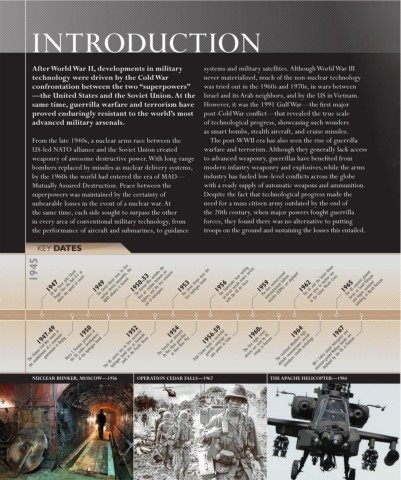
              KEY DATES
              1945
                                    The Soviet Union tests its first
                                                                                                              The US and the Soviet Union
                                                 The Korean War includes the
                                                                                The Sidewinder heat seeking
                                                                                 air-to-air missile enters service
                                                                  The Soviet Union tests the
                                     nuclear device; meanwhile, the
                   US Air Force pilot Chuck
                                                                                                                             The US commits ground
                                                    fighters, and the first extensive
                                                   first air combat between jet
                                                                                                               come close to nuclear war
                     Yeager flies the Bell X-1 at
                                                                                               The first nuclear-armed
                                                                                                                              forces to South Vietnam
                                                                                                intercontinental ballistic
                                                                                                                                bombing of North Vietnam
                                                                    first hydrogen bomb
                  1947  above the speed of sound  1949  NATO alliance is formed  1950–53   1953   1956  with the US Air Force  1959  missiles (ICBMs) are deployed  1962  in the Cuban Missile Crisis  1965  and begins sustained
                                                     use of helicopters
               1947–49
                                                                          1956–59
                                                                                                                        1967
                              1950
                                               1952
                                                             1954
                                                                                                          1964
                                                                                          1960s
           The Chinese Civil War results in      Harry S Truman, president of     The US carries out its first successful   The French are defeated         Fidel Castro leads a successful      The first night vision   The Lockheed Blackbird high-  AH-1 Cobra attack helicopters and
                                                                                                                  television-guided Walleye bombs are
                                                                                                     altitude reconnaissance aircraft
                                         hydrogen bomb test, on Eniwetok
                                                                           guerrilla campaign to
                                                            by Viet Minh guerrillas
                          the US, orders development
                                                                                         devices are used by US
            the establishment of a communist
                                                              at Dien Bien Phu
                             of the hydrogen bomb
                                             atoll, in the Pacific Ocean
                                                                                                                     deployed by the US, in Vietnam
                                                                            take power in Cuba
                                                                                            troops in Vietnam
                 government in Beijing
                                                                                                       introduces stealth technology
            NUCLEAR BUNKER, MOSCOW—1956           OPERATION CEDAR FALLS—1967                     THE APACHE HELICOPTER—1984

