


Page 127 - (DK Eyewitness) Travel Guide - India
P. 127
HIM A CHAL PR ADESH 125
the 10th century and carved in Built by the Kangra kings in
a style similar to those at Ellora the early 18th century, it was
(see pp480–82). The picturesque the favoured residence of Raja
Jwalamukhi Temple, 35 km Sansar Chand, the renowned
(22 miles) southwest of Kangra, patron of Kangra miniature
is one of North India’s most painting. The fortress also has the
important pilgrimage sites. remains of fine old wall paintings.
Further east of Kangra, the At the far end of the Kangra
beauty of the tea garden country Valley is Jogindernagar, 55 km
unfolds around Palampur, (34 miles) south of Palampur, and
45 km (28 miles) away. East of the terminus of a narrow-gauge
Palampur is the 9th-century railway line that winds up the
stone Baijnath Temple dedicated valley from Pathankot in the west.
The towering spire of Brajeshwari Devi to Shiva, Bir with its Tibetan The Maharana Pratap Sagar
Temple in Kangra town Buddhist monastery, and Billing, Lake, created in 1979 by the
well known as a take-off point construction of the Pong Dam
of a steep cliff overlooking the for paragliding over the valley. across the Beas, lies to the
Banganga and Majhi rivulets. About 40 km (25 miles) southwest of Kangra district.
Within the fort’s compound are southeast of Palampur, is the This large wetland is a favoured
two Hindu temples dedicated fortress of Sujanpur-Tira, located stopover for migratory birds
to Ambika Devi (a local on the right bank of the Beas. from Central Asia.
goddess) and Lakshmi Narayan,
and a Jain temple with a stone
image of Adinath. Behind the
crowded bazaar is the
Brajeshwari Devi Temple, whose
fabled riches were plundered by
Mahmud of Ghazni (see p49) in
1009. The present structure was
built in 1920, after the terrible
earthquake of 1905 destroyed
the city and original temple.
Some 40 km (25 miles)
southwest of Kangra town,
are the 15 monolithic rock-cut
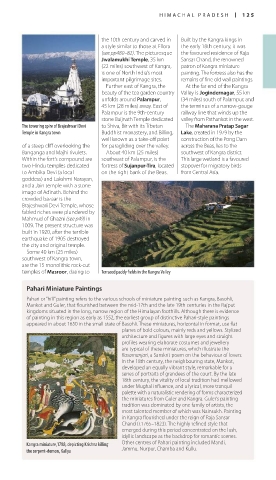
temples of Masroor, dating to Terraced paddy fields in the Kangra Valley
Pahari Miniature Paintings
Pahari or “hill” painting refers to the various schools of miniature painting such as Kangra, Basohli,
Mankot and Guler, that flourished between the mid-17th and the late 19th centuries in the Rajput
kingdoms situated in the long, narrow region of the Himalayan foothills. Although there is evidence
of painting in this region as early as 1552, the earliest group of distinctive Pahari-style paintings
appeared in about 1650 in the small state of Basohli. These miniatures, horizontal in format, use flat
planes of bold colours, mainly reds and yellows. Stylized
architecture and figures with large eyes and straight
profiles wearing elaborate costumes and jewellery
are typical of these miniatures, which illustrate the
Rasamanjari, a Sanskrit poem on the behaviour of lovers.
In the 18th century, the neighbouring state, Mankot,
developed an equally vibrant style, remarkable for a
series of portraits of grandees of the court. By the late
18th century, the vitality of local tradition had mellowed
under Mughal influence, and a lyrical, more tranquil
palette with a naturalistic rendering of forms characterized
the miniatures from Guler and Kangra. Guler’s painting
tradition was dominated by one family of artists, the
most talented member of which was Nainsukh. Painting
in Kangra flourished under the reign of Raja Sansar
Chand (r.1765–1823). The highly refined style that
emerged during this period concentrated on the lush,
idyllic landscape as the backdrop for romantic scenes.
Kangra miniature,1788, depicting Krishna killing Other centres of Pahari painting included Mandi,
the serpent-demon, Kaliya Jammu, Nurpur, Chamba and Kullu.
124-125_EW_India.indd 125 26/04/17 11:53 am

