


Page 131 - (DK Eyewitness) Travel Guide - India
P. 131
HIM A CHAL PR ADESH 129
(see p117). The main motor
road continues up to Hadsar,
16 km (10 miles) beyond
Bharmour, and from there the
yatra (procession) ascends in
two stages via Dhanchho to
the lake, nestling at the base
of the Manimahesh Kailasa.
For the adventurous,
Bharmour also offers a tough
five-day trek over the Kugti Pass
(5,040 m/16,535 ft) to Lahaul
(see p133). Holi, 26 km (16 miles)
Hillsides around Chamba ablaze with the colours of autumn away in the main Ravi Valley, is
the base for a number of trails
are the six North Indian shikhara- mountainside, high above Budhil, over the Dhauladhar Range
style temples (see p24) that a large tributary of the Ravi river. to the Kangra Valley. It offers
comprise the Lakshmi Narayan Bharmour’s main attraction is an option of a longer walk to
Temple complex, to the west of the fascinating Chaurasi (literally, the Kullu Valley as well. Down
the Chaugan. Of these, three are “Eighty-Four”) Temple complex, the course of the Ravi, on the
dedicated to Vishnu and three built in the 10th century under road to Chamba, the Chatrari
to Shiva. The white marble image Raja Sahil Varman to honour the Temple with its exquisite
of Lakshmi Narayan, in the main 84 saints who visited Bharmour. bronze image of Shakti Devi,
temple, was brought from Central The major shrines are dedicated is also worth a stop.
India in the 10th century. The to Narasimha, Ganesha, and the
carved panels on the temple local deities Larkana Devi and
walls illustrate mythological Manimahesh. The intricate
scenes as well as animal and wooden carvings on the temple
floral motifs. lintels and the images of the
Other temples include the main deities are outstanding,
Madho Rai Temple, near the and it is said that the sculptor’s
palace, with a bronze image hands were cut off to prevent
of Krishna, and further up, the him from replicating such
Chamunda Temple. remarkable work.
A glimpse of Chamba’s rich
heritage can be seen at the Environs
Bhuri Singh Museum, set up Situated at a height of 3,950 m
in 1908 by the king of Chamba (12,959 ft), Manimahesh Lake,
at the time. His rare collection 35 km (22 miles) from Bharmour,
of miniature paintings formed is the area’s most sacred lake,
the nucleus of the museum. as its holy waters are believed
Today, it has a fine collection to cleanse all sins. In August/
of Pahari paintings (see p125), September, thousands of pilgrims
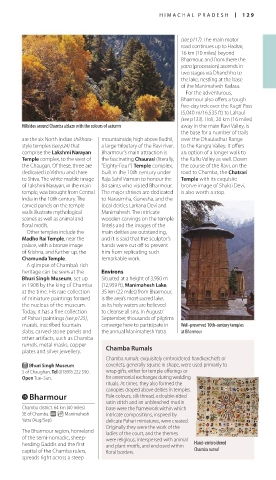
murals, inscribed fountain converge here to participate in Well-preserved 10th-century temples
slabs, carved-stone panels and the annual Manimahesh Yatra at Bharmour
other artifacts, such as Chamba
rumals, metal masks, copper Chamba Rumals
plates and silver jewellery.
Chamba rumals, exquisitely embroidered handkerchiefs or
E Bhuri Singh Museum coverlets, generally square in shape, were used primarily to
S of Chaughan. Tel (01899) 222 590. wrap gifts, either for temple offerings or
Open Tue–Sun. for ceremonial exchanges during wedding
rituals. At times, they also formed the
canopies draped above deities in temples.
t Bharmour Pale colours, silk thread, a double-sided
satin stitch and an unbleached muslin
Chamba district. 64 km (40 miles) base were the framework within which
SE of Chamba. @ _ Manimahesh intricate compositions, inspired by
Yatra (Aug/Sep). delicate Pahari miniatures, were created.
Originally they were the work of the
The Bharmour region, homeland ladies of the court, and the themes
of the semi-nomadic, sheep- were religious, interspersed with animal
herding Gaddis and the first and plant motifs, and enclosed within Hand-embroidered
capital of the Chamba rulers, floral borders. Chamba rumal
spreads right across a steep
128-129_EW_India.indd 129 26/04/17 11:43 am

