


Page 132 - (DK Eyewitness) Travel Guide - India
P. 132
130 DELHI & THE NOR TH
Jagannathi Devi Temple at
Bekhli, 5 km (3 miles) to the
north; and the Vishnu Temple at
Dayar, 12 km (7 miles) to the
west. The pyramidal Basheshwar
Mahadev Temple at Bajaura,
15 km (9 miles) to the south,
has superb images of Vishnu,
Ganesha and Durga. However,
the most famous is the Bijli
Mahadev Temple, dedicated to
the “Lord of Lightning”, 14 km
(9 miles) to the southeast.
Located on a high spur on the
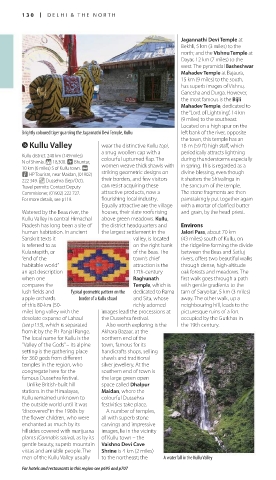
Brightly coloured tiger guarding the Jagannathi Devi Temple, Kullu left bank of the river, opposite
the town, this temple has an
y Kullu Valley wear the distinctive Kullu topi, 18-m (59-ft) high staff, which
a snug woollen cap with a periodically attracts lightning
Kullu district. 240 km (149 miles) colourful upturned flap. The during thunderstorms especially
N of Shimla. * 18,300. ~ Bhuntar,
10 km (6 miles) S of Kullu town. @ women weave thick shawls with in spring. This is regarded as a
n HP Tourism, near Maidan, (01902) striking geometric designs on divine blessing, even though
222 349. _ Dussehra (Sep/Oct). their borders, and few visitors it shatters the Shivalinga in
Travel permits: Contact Deputy can resist acquiring these the sanctum of the temple.
Commisioner, (01902) 222 727. attractive products, now a The stone fragments are then
For more details, see p119. flourishing local industry. painstakingly put together again
Equally attractive are the village with a mortar of clarified butter
Watered by the Beas river, the houses, their slate roofs rising and grain, by the head priest.
Kullu Valley in central Himachal above green meadows. Kullu,
Pradesh has long been a site of the district headquarters and Environs
human habitation. In ancient the largest settlement in the Jalori Pass, about 70 km
Sanskrit texts it valley, is located (43 miles) south of Kullu, on
is referred to as on the right bank the ridgeline forming the divide
Kulantapith, or of the Beas. The between the Beas and Satluj
“end of the town’s chief rivers, offers two beautiful walks
habitable world” – attraction is the through dense, high-altitude
an apt description 17th-century oak forests and meadows. The
when one Raghunath first walk goes through a path
compares the Temple, which is with gentle gradients to the
lush fields and Typical geometric pattern on the dedicated to Rama tarn of Saryolsar, 5 km (3 miles)
apple orchards border of a Kullu shawl and Sita, whose away. The other walk, up a
of this 80-km (50- richly adorned neighbouring hill, leads to the
mile) long valley with the images lead the proces sions at picturesque ruins of a fort
desolate expanse of Lahaul the Dussehra festival. occupied by the Gurkhas in
(see p133), which is separated Also worth exploring is the the 19th century.
from it by the Pir Panjal Range. Akhara Bazaar, at the
The local name for Kullu is the northern end of the
“Valley of the Gods” – its alpine town, famous for its
setting is the gathering place handicrafts shops, selling
for 360 gods from dif ferent shawls and traditional
temples in the region, who silver jewellery. At the
congregate here for the southern end of town is
famous Dussehra festival. the large green open
Unlike British-built hill space called Dhalpur
stations in the Himalayas, Maidan, where the
Kullu remained unknown to colourful Dussehra
the outside world until it was festivities take place.
“discovered” in the 1960s by A number of temples,
the flower children, who were all with superb stone
enchanted as much by its carvings and impressive
hillsides covered with marijuana images, lie in the vicinity
plants (Cannabis sativa), as by its of Kullu town – the
gentle beauty, superb mountain Vaishno Devi Cave
vistas and amiable people. The Shrine is 4 km (2 miles)
men of the Kullu Valley usually to the northeast; the A waterfall in the Kullu Valley
For hotels and restaurants in this region see p695 and p707
130-131_EW_India.indd 130 26/04/17 11:43 am
Eyewitness Travel LAYERS PRINTED:
Catalogue template “UK” LAYER
(Source v2.6)
Date 12th July 2013
Size 125mm x 217mm

