


Page 174 - (DK Eyewitness) Travel Guide - India
P. 174
172 CENTR AL INDIA
1 Agra
Agra was the seat of the imperial Mughal court during the
16th and 17th centuries, before the capital was shifted to Delhi.
The city, strategically located on the banks of the Yamuna and
along the Grand Trunk Road, flourished under the patronage
of the emperors Akbar, Jahangir and Shah Jahan, attracting
artisans from Persia and Central Asia, and also from other
parts of India, who built luxurious forts, palaces, gardens and
mausoleums. Of these, the Taj Mahal, the Agra Fort and Akbar’s
abandoned capital of Fatehpur Sikri have been declared
World Heritage Sites by UNESCO. With the decline of the
Mughals, Agra was captured by the Jats, the Marathas and,
finally by the British, early in the 19th century.
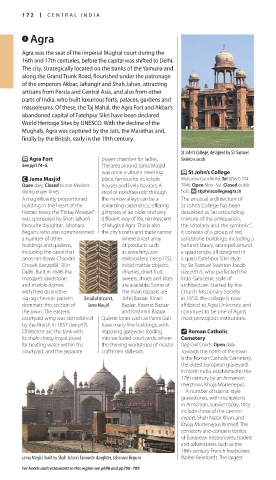
St John’s College, designed by Sir Samuel
P Agra Fort prayer chamber for ladies. Swinton Jacob
See pp174–5. The area around Jama Masjid
was once a vibrant meeting P St John’s College
U Jama Masjid place, famous for its kebab Mahatma Gandhi Rd. Tel (0562) 324
Open daily. Closed to non-Muslims houses and lively bazaars. A 7846. Open Mon–Sat. Closed public
during prayer times. stroll or rickshaw ride through hols. ∑ stjohnscollegeagra.in
A magnificently proportioned the narrow alleys can be a The unusual architecture of
building in the heart of the rewarding experience, offering St John’s College has been
historic town, the “Friday Mosque” glimpses of an older and very described as “an astounding
was sponsored by Shah Jahan’s different way of life, reminiscent mixture of the antiquarian,
favourite daughter, Jahanara of Mughal Agra. This is also the scholarly and the symbolic”.
Begum, who also commissioned the city’s crafts and trade centre It consists of a group of red
a number of other where a vast array sandstone buildings, including a
buildings and gardens, of products such hall and library, arranged around
including the canal that as jewellery, zari a quadrangle, all designed in
once ran down Chandni embroidery (see p175), a quasi-Fatehpur Sikri style
Chowk (see pp88–9) in inlaid marble objects, by Sir Samuel Swinton Jacob
Delhi. Built in 1648, the dhurries, dried fruit, (see p357), who perfected the
mosque’s sandstone sweets, shoes and kites Indo-Saracenic style of
and marble domes are available. Some of architecture. Started by the
with their distinctive the main bazaars are Church Missionary Society
zigzag chevron pattern Detail of minaret, Johri Bazaar, Kinari in 1850, the college is now
dominate this section of Jama Masjid Bazaar, Kaserat Bazaar affiliated to Agra University and
the town. The eastern and Kashmiri Bazaar. continues to be one of Agra’s
courtyard wing was demolished Quieter lanes such as Panni Gali most prestigious institutions.
by the British in 1857 (see p57). have many fine buildings, with
Of interest are the tank with imposing gateways leading Z Roman Catholic
its shahi chirag (royal stove) into secluded courtyards, where Cemetery
for heating water within the the thriving workshops of master Opp Civil Courts. Open daily.
courtyard, and the separate craftsmen still exist. Towards the north of the town
is the Roman Catholic Cemetery,
the oldest European graveyard
in North India, established in the
17th century by an Armenian
merchant, Khoja Mortenepus.
A number of Islamic-style
gravestones, with inscriptions
in Armenian, survive today; they
include those of the cannon
expert, Shah Nazar Khan, and
Khoja Mortenepus himself. The
cemetery also contains tombs
of European missionaries, traders
and adventurers such as the
18th-century French freebooter,
Jama Masjid, built by Shah Jahan’s favourite daughter, Jahanara Begum Walter Reinhardt. The largest
For hotels and restaurants in this region see p696 and pp708–709
172-173_EW_India.indd 172 26/04/17 11:43 am
Eyewitness Travel LAYERS PRINTED:
Catalogue template “UK” LAYER
(Source v2.4)
Date 25th April 2013
Size 125mm x 217mm

