


Page 205 - (DK Eyewitness) Travel Guide - India
P. 205
UT T AR PR ADESH & UT T AR AKHAND 203
g Jaunpur
Jaunpur district. 250 km (155 miles) SE
of Lucknow. * 4,494,204. £ @
Though largely bypassed by
visitors, Jaunpur has a wealth
of medieval Islamic architecture.
Located along the Gomti river,
Jaunpur was established by
Feroze Shah Tughluq (see p95) in
the late 14th century and soon
grew into an important trading
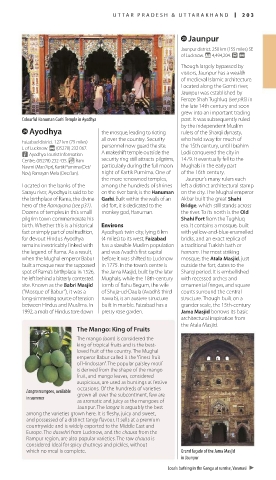
Colourful Hanuman Garhi Temple in Ayodhya post. It was subsequently ruled
by the independent Muslim
f Ayodhya the mosque, leading to rioting rulers of the Sharqi dynasty,
all over the country. Security who held sway for much of
Faizabad district. 127 km (79 miles)
E of Lucknow. @ (05278) 232 067. personnel now guard the site. the 15th century, until Ibrahim
n Ayodhya Tourist Information A makeshift temple outside the Lodi conquered the city in
Centre, (05278) 232 435. _ Ram security ring still attracts pilgrims, 1479. It eventually fell to the
Navmi (Mar/Apr), Kartik Purnima (Oct/ particularly during the full moon Mughals in the early part
Nov), Ramayan Mela (Dec/Jan). night of Kartik Purnima. One of of the 16th century.
the more renowned temples, Jaunpur’s many rulers each
Located on the banks of the among the hundreds of shrines left a distinct architectural stamp
Sarayu river, Ayodhya is said to be on the river bank, is the Hanuman on the city. The Mughal emperor
the birthplace of Rama, the divine Garhi. Built within the walls of an Akbar built the great Shahi
hero of the Ramayana (see p31). old fort, it is dedicated to the Bridge, which still stands across
Dozens of temples in this small monkey god, Hanuman. the river. To its north is the Old
pilgrim town com memo rate his Shahi Fort from the Tughluq
birth. Whether this is a historical Environs era. It contains a mosque, built
fact or simply part of oral tradition, Ayodhya’s twin city, lying 6 km with yellow-and-blue enamelled
for devout Hindus Ayodhya (4 miles) to its west, Faizabad bricks, and an exact replica of
remains inextricably linked with has a sizeable Muslim population a traditional Turkish bath or
the legend of Rama. As a result, and was Avadh’s first capital hamam. The most striking
when the Mughal emperor Babur before it was shifted to Lucknow mosque, the Atala Masjid, just
built a mosque near the supposed in 1775. In the town’s centre is outside the fort, dates to the
spot of Rama’s birthplace in 1526, the Jama Masjid, built by the later Sharqi period. It is embellished
he left behind a bitterly contested Mughals, while the 18th-century with recessed arches and
site. Known as the Babri Masjid tomb of Bahu Begum, the wife ornamental fringes, and square
(“Mosque of Babur”), it was a of Shuja-ud-Daula (Avadh’s third courts surround the central
long-simmering source of tension nawab), is an austere structure structure. Though built on a
between Hindus and Muslims. In built in marble. Faizabad has a grander scale, the 15th-century
1992, a mob of Hindus tore down pretty rose garden. Jama Masjid borrows its basic
architectural inspiration from
the Atala Masjid.
The Mango: King of Fruits
The mango (aam) is considered the
king of tropical fruits and is the best-
loved fruit of the country. The Mughal
emperor Babur called it the “finest fruit
of Hindostan”. The popular paisley motif
is derived from the shape of the mango
fruit, and mango leaves, considered
auspicious, are used as buntings at festive
occasions. Of the hundreds of varieties
Langra mangoes, available grown all over the subcontinent, few are
in summer
as aromatic and juicy as the mangoes of
Jaunpur. The langra is arguably the best
among the varieties grown here. It is fleshy, juicy and sweet,
and possessed of a distinct tangy flavour. It sells at a premium
countrywide and is widely exported to the Middle East and
Europe. The dussehri from Lucknow, and the chausa from the
Rampur region, are also popular varieties. The raw chausa is
considered ideal for spicy chutneys and pickles, without
which no meal is complete. Grand façade of the Jama Masjid
in Jaunpur
Locals bathing in the Ganga at sunrise, Varanasi
202-203_EW_India.indd 203 26/04/17 11:44 am

