


Page 214 - (DK Eyewitness) Travel Guide - India
P. 214
212 CENTR AL INDIA
Exploring Varanasi j Sarnath
Varanasi, one of the oldest cities in the world and a Varanasi district. 10 km (6 miles)
NE of Varanasi. @ _ Buddha
contemporary of Babylon and Nineveh, dates to the 7th Mahotsava (May).
century BC. This eternal city, where religion is an integral
part of daily life, has drawn saints, poets and pilgrims through To Buddhists, Sarnath is as
sacred as Varanasi is to Hindus.
the ages. Behind the riverside ghats are narrow, crowded lanes The Buddha came to the Deer
and bazaars, where people jostle with sacred cows, saffron- Park here in 528 BC, to preach
robed sadhus and devotees making offerings at roadside the Dharmachakra, or the Wheel
shrines. Varanasi is also renowned as a centre of Sanskrit of Law, his first major sermon
learning and Hindu philosophy, attracting scholars and after gaining enlightenment
students from all over India. The Benares Hindu University, (see p225). Sarnath was then
one of ancient India’s greatest
established in the early 1900s, perpetuates this tradition. centres of learning, visited by
Chinese travellers Fa-Hsien and
Hiuen Tsang, who wrote of its
flourishing monasteries.
The central monument of
the existing complex is the
5th-century AD Dhamekh
Stupa, which is built at the site
where the Buddha is believed
to have delivered his sermon to
five disciples. To its west, are
the remains of the Dharmarajika
Stupa, built by the Mauryan
emperor Ashoka (see p46) to
preserve the Buddha’s relics.
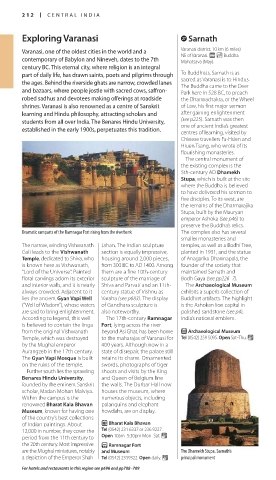
Dramatic ramparts of the Ramnagar Fort rising from the riverbank The complex also has several
smaller monasteries and
The narrow, winding Vishwanath Jahan. The Indian sculpture temples, as well as a Bodhi Tree,
Gali leads to the Vishwanath section is equally impressive, planted in 1931, and the statue
Temple, dedicated to Shiva, who housing around 2,000 pieces, of Anagarika Dharmapala, the
is known here as Vishwanath, from 300 BC to AD 1400. Among founder of the society that
“Lord of the Universe”. Painted them are a fine 10th-century maintained Sarnath and
floral carvings adorn its exterior sculpture of the marriage of Bodh Gaya (see pp226–7).
and interior walls, and it is nearly Shiva and Parvati and an 11th- The Archaeological Museum
always crowded. Adjacent to it century statue of Vishnu as exhibits a superb collection of
lies the ancient Gyan Vapi Well Varaha (see p683). The display Buddhist artifacts. The highlight
(“Well of Wisdom”), whose waters of Gandhara sculpture is is the Ashokan lion capital in
are said to bring enlightenment. also noteworthy. polished sandstone (see p4),
According to legend, this well The 17th-century Ram nagar India’s national emblem.
is believed to contain the linga Fort, lying across the river
from the original Vishwanath beyond Asi Ghat, has been home E Archaeological Museum
Temple, which was destroyed to the maharajas of Varanasi for Tel (0542) 259 5095. Open Sat–Thu. &
by the Mughal emperor 400 years. Although now in a
Aurangzeb in the 17th century. state of disrepair, the palace still
The Gyan Vapi Mosque is built retains its charm. Ornamented
on the ruins of the temple. swords, photographs of tiger
Further south lies the sprawling shoots and visits by the King
Benares Hindu University, and Queen of Belgium line
founded by the eminent Sanskrit the walls. The Durbar Hall now
scholar, Madan Mohan Malviya. houses the museum, where
Within the campus is the numerous objects, including
renowned Bharat Kala Bhavan palanquins and elephant
Museum, known for having one howdahs, are on display.
of the country’s best collections
of Indian paint ings. About E Bharat Kala Bhavan
12,000 in number, they cover the Tel (0542) 231 6337 or 236 9227.
period from the 11th century to Open 10am–5:30pm Mon–Sat. &
the 20th century. Most impressive P Ramnagar Fort
are the Mughal miniatures, notably and Museum The Dhamekh Stupa, Sarnath’s
a depiction of the Emperor Shah Tel (0542) 2339322. Open daily. & principal monument
For hotels and restaurants in this region see p696 and pp708–709
212-213_EW_India.indd 212 26/04/17 11:44 am
Eyewitness Travel LAYERS PRINTED:
Catalogue template “UK” LAYER
(Source v2.6)
Date 12th July 2013
Size 125mm x 217mm

