


Page 217 - (DK Eyewitness) Travel Guide - India
P. 217
UT T AR PR ADESH & UT T AR AKHAND 215
Environs
Kausambi, is 63 km (39 miles)
and about an hour’s drive from
Allahabad on the eastern bank
of the Yamuna. Excavated
ruins of a stupa, a palace and
extensive ramparts lie within
a 2-km (1-mile) radius. While
local legend holds that the
city was built by the Pandavas,
heroes of the Mahabharata (see
p30), excavations reveal that a
Buddhist community flourished
here between 600 BC and
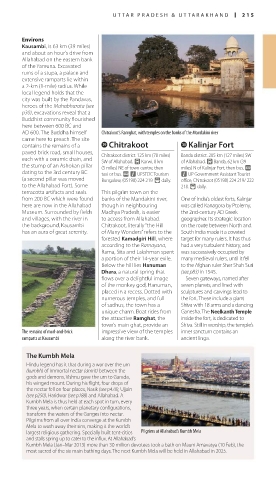
AD 600. The Buddha himself Chitrakoot’s Ramghat, with temples on the banks of the Mandakini river
came here to preach. The site
contains the remains of a l Chitrakoot z Kalinjar Fort
paved brick road, small houses, Chitrakoot district. 125 km (78 miles) Banda district. 205 km (127 miles) SW
each with a ceramic drain, and SW of Allahabad. £ Karwi, 8 km of Allahabad. £ Banda, 62 km (39
the stump of an Ashokan pillar (5 miles) NE of town centre, then miles) N of Kalinjar Fort, then bus. @
dating to the 3rd century BC taxi or bus. @ n UPSTDC Tourism n UP Government Assistant Tourist
(a second pillar was moved Bungalow, (05198) 224 219. ( daily. office, Chitrakoot (05198) 224 219/ 222
to the Allahabad Fort). Some 218. ( daily.
terracotta artifacts and seals This pilgrim town on the
from 200 BC which were found banks of the Mandakini river, One of India’s oldest forts, Kalinjar
here are now in the Allahabad though in neighbouring was called Kanagora by Ptolemy,
Museum. Surrounded by fields Madhya Pradesh, is easier the 2nd-century AD Greek
and villages, with the river in to access from Allahabad. geographer. Its strategic location
the background, Kausambi Chitrakoot, literally “the Hill on the route between North and
has an aura of great serenity. of Many Wonders” refers to the South India made it a coveted
forested Kamadgiri Hill, where target for many rulers. It has thus
according to the Ramayana, had a very turbulent history, and
Rama, Sita and Lakshman spent was successively occupied by
a portion of their 14-year exile. many medieval rulers, until it fell
Below the hill lies Hanuman to the Afghan ruler Sher Shah Suri
Dhara, a natural spring that (see p83) in 1545.
flows over a delightful image Seven gateways, named after
of the monkey god, Hanuman, seven planets, and lined with
placed in a recess. Dotted with sculptures and carvings lead to
numerous temples, and full the fort. These include a giant
of sadhus, the town has a Shiva with 18 arms and a dancing
unique charm. Boat rides from Ganesha. The Neelkanth Temple
the attractive Ramghat, the inside the fort, is dedicated to
town’s main ghat, provide an Shiva. Still in worship, the temple’s
The remains of mud-and-brick impressive view of the temples inner sanctum contains an
ramparts at Kausambi along the river bank. ancient linga.
The Kumbh Mela
Hindu legend has it that during a war over the urn
(kumbh) of immortal nectar (amrit) between the
gods and demons, Vishnu gave the urn to Garuda,
his winged mount. During his flight, four drops of
the nectar fell on four places, Nasik (see p478), Ujjain
(see p250), Haridwar (see p188) and Allahabad. A
Kumbh Mela is thus held at each spot in turn, every
three years, when certain planetary configurations,
transform the waters of the Ganges into nectar.
Pilgrims from all over India converge at the Kumbh
Mela to wash away their sins, making it the world’s
largest religious gathering. Specially built tent-cities Pilgrims at Allahabad’s Kumbh Mela
and stalls spring up to cater to the influx. At Allahabad’s
Kumbh Mela (Jan–Mar 2013) more than 30 million devotees took a bath on Mauni Amavasya (10 Feb), the
most sacred of the six main bathing days. The next Kumbh Mela will be held in Allahabad in 2025.
214-215_EW_India.indd 215 26/04/17 11:53 am

