


Page 215 - (DK Eyewitness) Travel Guide - India
P. 215
UT T AR PR ADESH & UT T AR AKHAND 213
Brocades from Varanasi
Varanasi, India’s most ancient pilgrimage centre, is also famous for its textiles. The city
has been renowned for its gossamer-fine cotton weaves for over 2000 years, but its
weaving traditions acquired new splendour from the 16th century onwards, with the
patronage of the Mughal emperors. Varanasi’s weavers soon became adept at weaving
silk with gold and silver thread, to create sumptuous brocades for royal costumes and
court furnishings, embellished with the exquisite floral, animal and geometric motifs
favoured by the Mughals. They also produced brocades for Tibetan monasteries,
decorated with Buddhist motifs such as clouds, lotus flowers and flames. Today, a wide
range of brocade saris, scarves, and Tibetan-style fabrics are made and sold in the city.
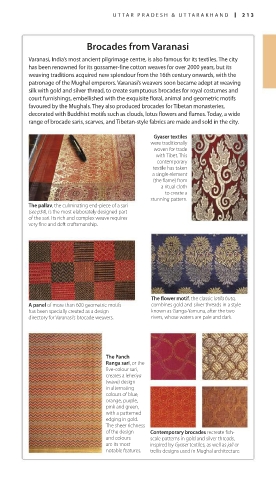
Gyaser textiles
were traditionally
woven for trade
with Tibet. This
contemporary
textile has taken
a single element
(the flame) from
a ritual cloth
to create a
stunning pattern.
The pallav, the culminating end-piece of a sari
(see p34), is the most elaborately designed part
of the sari. Its rich and complex weave requires
very fine and deft craftsmanship.
The flower motif, the classic latifa buta,
A panel of more than 600 geometric motifs combines gold and silver threads in a style
has been specially created as a design known as Ganga-Yamuna, after the two
directory for Varanasi’s brocade weavers. rivers, whose waters are pale and dark.
The Panch
Ranga sari, or the
five-colour sari,
creates a leheriya
(wave) design
in alternating
colours of blue,
orange, purple,
pink and green,
with a patterned
edging in gold.
The sheer richness
of the design Contemporary brocades recreate fish-
and colours scale patterns in gold and silver threads,
are its most inspired by Gyaser textiles, as well as jali or
notable features. trellis designs used in Mughal architecture.
212-213_EW_India.indd 213 26/04/17 11:44 am

