


Page 267 - (DK Eyewitness) Travel Guide - India
P. 267
INTRODUCING EASTERN INDIA 265
cultural and religious life
still revolves around its
serene and beautiful
Buddhist monasteries.
In the extreme eastern
corner of India are Assam
and the six north eastern
states of Arunachal Pradesh,
Meghalaya, Manipur,
Mizoram, Nagaland and
Tripura, connected to the
Idol of Goddess Durga, whose festival, Durga Puja, is Hinduism’s biggest rest of the country only by
a thin corridor of land.
India, lost the assembly elections. The This region is home to dozens of tribal
culture of flag-waving processions, however, communities, each with its own language
blends flawlessly with the typical Kolkata and culture (see pp340–41).
pastime of adda – a lively mix of heated Tea dominates the economy of Assam,
political debate, highbrow analyses and which produces more than half the tea
lowbrow gossip. This is all played out grown in India, as well much of
against a backdrop of crumbling the country’s oil. The other six
vestiges of some splendid states have rich agricultural and
colonial architecture. forest resources, and little
From Kolkata, many visitors industry. The isolation of the
travel south to the beaches and Northeastern states, and their
exquisitely sculpted temples of shared borders with Bangladesh,
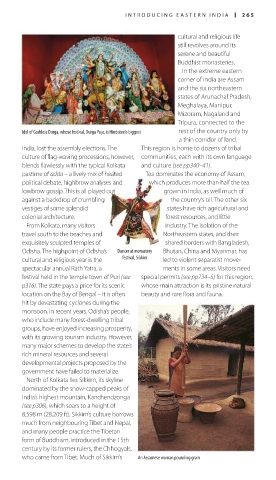
Odisha. The highpoint of Odisha’s Dancer at monastery Bhutan, China and Myanmar, has
cultural and religious year is the festival, Sikkim led to violent separatist move-
spectacular annual Rath Yatra, a ments in some areas. Visitors need
festival held in the temple town of Puri (see special permits (see pp734–5) for this region,
p316). The state pays a price for its scenic whose main attraction is its pristine natural
location on the Bay of Bengal – it is often beauty and rare flora and fauna.
hit by devastating cyclones during the
monsoon. In recent years, Odisha’s people,
who include many forest-dwelling tribal
groups, have enjoyed increasing prosperity,
with its growing tourism industry. However,
many major schemes to develop the state’s
rich mineral resources and several
developmental projects proposed by the
government have failed to materialize.
North of Kolkata lies Sikkim, its sky line
dominated by the snow-capped peaks of
India’s highest mountain, Kanchendzonga
(see p306), which soars to a height of
8,598 m (28,209 ft). Sikkim’s culture borrows
much from neighbouring Tibet and Nepal,
and many people practice the Tibetan
form of Buddhism, introduced in the 15th
century by its former rulers, the Chhogyals,
who came from Tibet. Much of Sikkim’s An Assamese woman pounding grain
264-265_EW_India.indd 265 26/04/17 11:53 am

