


Page 269 - (DK Eyewitness) Travel Guide - India
P. 269
INTRODUCING EASTERN INDIA 267
Darjeeling tea logo
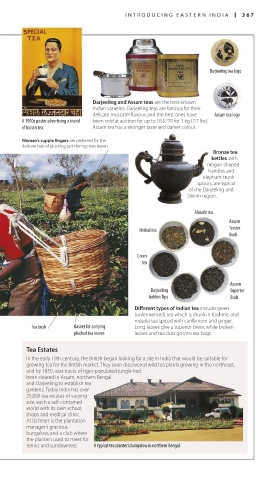
Darjeeling and Assam teas are the best-known
Indian varieties. Darjeeling teas are famous for their
delicate muscatel flavour, and the best ones have Assam tea logo
A 1950s poster advertising a brand been sold at auction for up to US$220 for 1 kg (2.2 lbs).
of Indian tea Assam tea has a stronger taste and darker colour.
Women’s supple fingers are preferred for the
delicate task of plucking just the top two leaves.
Bronze tea
kettles with
dragon-shaped
handles and
elephant trunk
spouts, are typical
of the Darjeeling and
Sikkim region.
Masala tea
Assam
Herbal tea Tender
Buds
Green
tea
Assam
Darjeeling Superior
Golden Tips Buds
Different types of Indian tea include green
(unfermented) tea which is drunk in Kashmir, and
masala tea spiced with cardamom and ginger.
Tea bush Basket for carrying Long leaves give a superior brew, while broken
plucked tea leaves leaves and tea dust go into tea bags.
Tea Estates
In the early 19th century, the British began looking for a site in India that would be suitable for
growing tea for the British market. They soon discovered wild tea plants growing in the northeast,
and by 1850, vast tracts of tiger-populated jungle had
been cleared in Assam, northern Bengal
and Darjeeling to establish tea
gardens. Today India has over
25,000 tea estates of varying
size, each a self-contained
world with its own school,
shops and medical clinic.
At its heart is the plantation
manager’s gracious
bungalow, and a club where
the planters used to meet for
tennis and sundowners. A typical tea planter’s bungalow in northern Bengal
266-267_EW_India.indd 267 26/04/17 11:45 am

