


Page 276 - (DK Eyewitness) Travel Guide - India
P. 276
274 EASTERN INDIA
1 Street-by-Street: Around BBD Bagh
This is the “heart” of Kolkata and was the site of
the original Kolikata, one of the villages from which
the city grew. In 1930, three young Indian freedom
fighters, Binay, Badal and Dinesh, shot the British
inspector-general of police inside the Writers’ Building.
The square, now named after them, is ringed by British
colonial buildings, dating to the 18th and early 19th
centuries. These were once the centres of British
admin istrative and commercial control.
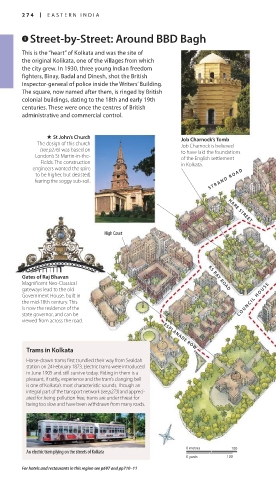
. St John’s Church Job Charnock’s Tomb
The design of this church Job Charnock is believed
(see p276) was based on to have laid the foundations
London’s St Martin-in-the- of the English settlement
Fields. The construction in Kolkata.
engineers wanted the spire
to be higher, but desisted,
fearing the soggy sub-soil. S T R A N D R O A D K O I L A G H AT S T R E E T
High Court HARE STREET
S T R E E T
Gates of Raj Bhavan KS RAY ROAD
Magnificent Neo-Classical
gateways lead to the old
Government House, built in
the mid-18th century. This C O U N C I L H O U S E
is now the residence of the R E D C R O S S P L A C E
state governor, and can be
viewed from across the road.
Trams in Kolkata ESPLANADE ROW
Horse-drawn trams first trundled their way from Sealdah
station on 24 February 1873. Electric trams were introduced
in June 1905 and still survive today. Riding in them is a
pleasant, if rattly, experience and the tram’s clanging bell
is one of Kolkata’s most characteristic sounds. Though an
integral part of the transport network (see p273) and appreci-
ated for being pollution free, trams are under threat for
being too slow and have been withdrawn from many roads.
0 metres 100
An electric tram plying on the streets of Kolkata
0 yards 100
For hotels and restaurants in this region see p697 and pp710–11
274-275_EW_India.indd 274 26/04/17 11:54 am

