


Page 273 - (DK Eyewitness) Travel Guide - India
P. 273
EASTERN INDIA 271
KOLKATA
One of the world’s great cities, Kolkata, or Calcutta as it
used to be known, has been through many incarnations.
From an obscure village on the banks of the Hooghly river,
it evolved into the capital of Great Britain’s Indian empire.
Today, this vibrant city with its distinct imperial flavour
is the capital of the state of West Bengal.
In 1690, an English merchant, Job Charnock, In 2001, Calcutta became Kolkata, the
established a trading post in the riverside Bengali pronunciation of its name. The
village of Sutanuti, which, together with city is crowded and dirty in places, but is
neighbouring Govindapur and Kolikata, nevertheless full of character. The teeming
grew into the city of Calcutta. Over the life of the waterfront along the Strand,
next 200 years, the city became a flourishing the noisy jumble of bazaars and pavement
commercial centre with imposing Victorian stalls, the residential streets with their
Gothic buildings, churches, and boulevards. once-gracious mansions, all make for an
Simultaneously, intellectual and cultural electric, cosmopolitan atmosphere, rarely
life bloomed, with a renaissance of Bengali found in other Indian cities. Kolkata’s
art and literature, and the growth of a charms straddle the decaying grandeur
strong nationalist reform movement that of the imperial capital and the smart
led to the founding of the Brahmo Samaj, restaurants and boutiques of Park Street.
an enlightened off-shoot of Hinduism, These coexist with the traditional Bengali
and the establishment of Presidency world of Rabindranath Tagore’s mansion
College, then the foremost centre of at Jorasanko, the Kalighat temple and the
English education. The decision to shift potters’ village of Kumartuli, and with
the capital to New Delhi in 1911 and the the lively politics of the Coffee House
urban decay of the 1960s diminished and the Maidan, dominated by the
some of the city’s affluence, but never Victoria Memorial, a spectacular symbol
quenched its effervescence. of imperial high noon.
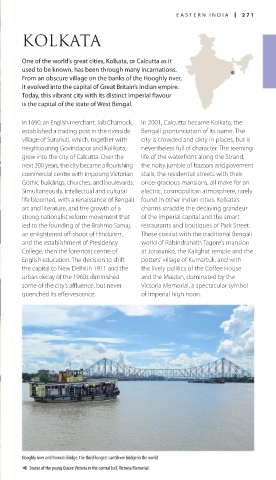
Hooghly river and Howrah Bridge, the third-longest cantilever bridge in the world
Statue of the young Queen Victoria in the central hall, Victoria Memorial
270-271_EW_India.indd 271 26/04/17 11:53 am

