


Page 308 - (DK Eyewitness) Travel Guide - India
P. 308
306 EASTERN INDIA
Trekking in West Bengal & Sikkim
Kanchendzonga
The eastern Himalayas, spanning Tibet, Nepal, West SIKKIM
Bengal and Sikkim, have some of the world’s highest Dzongri
peaks such as Kanchendzonga, Everest, Lhotse and •
Makalu, and offer a variety of trekking options amidst
lush hills bursting with orchids and rhododendron •
blossoms. The region is also alive with legends of the BENGAL Tsokha
WEST
Abominable Snowman or Yeti, a huge, ape-like creature, Bakhim •
who allegedly lives above the snowline. West Bengal’s
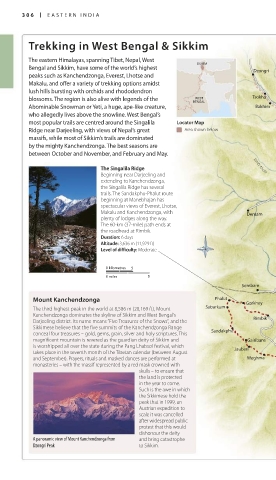
most popular trails are centred around the Singalila Locator Map
Ridge near Darjeeling, with views of Nepal’s great Area shown below
massifs, while most of Sikkim’s trails are dominated •Yuksam
by the mighty Kanchendzonga. The best seasons are Tashijom
•
between October and November, and February and May. Rathang Chhu
The Singalila Ridge Rimbi Khola
Beginning near Darjeeling and
extending to Kanchendzonga, Pemayangtse
•
the Singalila Ridge has several • Gezing
trails. The Sandakphu-Phalut route
beginning at Manebhajan has
spectacular views of Everest, Lhotse,
Makalu and Kanchendzonga, with Dentam
•
plenty of lodges along the way.
The 60-km (37-mile) path ends at
the roadhead at Rimbik.
Duration: 6 days Rishi Kh ola
Altitude: 3,636 m (11,929 ft)
Level of difficulty: Moderate
0 kilometres 5 • Rangeet
Soreng
0 miles 5
Rangeet
Sombare
• Naya Bazaar •
GANTOK,
Mount Kanchendzonga Phalut • • Gorkhey Ramam Tsomgo Lake
The third highest peak in the world at 8,586 m (28,169 ft), Mount Sabarkum •
Kanchendzonga dominates the skyline of Sikkim and West Bengal’s Rimbik •
Darjeeling district. Its name means “Five Treasures of the Snows”, and the
Sikkimese believe that the five summits of the Kanchendzonga Range Sandakphu • Darjeeling
conceal four treasures – gold, gems, grain, silver and holy scriptures. This •
magnificent mountain is revered as the guardian deity of Sikkim and • Gairibans
is worshipped all over the state during the Pang Lhabsol festival, which Jaubari •
takes place in the seventh month of the Tibetan calendar (between August •
and September). Prayers, rituals and masked dances are performed at Meghma • Manebhanjan
monasteries – with the massif represented by a red mask crowned with
skulls – to ensure that NH55
the land is protected
in the year to come.
Such is the awe in which
the Sikkimese hold the
peak that in 1999, an Kurseong •
Austrian expedition to
scale it was cancelled •
after widespread public Mirik
protest that this would
dishonour the deity
A panoramic view of Mount Kanchendzonga from and bring catastrophe SILIGURI
Dzongri Peak to Sikkim.
306-307_EW_India.indd 306 26/04/17 11:45 am
Eyewitness Travel LAYERS PRINTED:
Feature template “UK” LAYER
(SourceReport v1.3)
Date 18th October 2012
Size 125mm x 217mm

