


Page 304 - (DK Eyewitness) Travel Guide - India
P. 304
302 EASTERN INDIA
the rule of Palden Thondup Rumtek is an impressive com
Namgyal, the last Chogyal. plex, its flatroofed buildings
At the town’s northern edge topped with golden finials, and
is the early 20thcentury Enchey filled with treasures brought
Monastery, whose large prayer from the monastery in Tibet.
hall is full of murals and images, Especially splendid is the
represent ing the pantheon of reliquary chorten of the 16th
Mahayana Buddhist deities (see Karmapa, behind the main
p145). Enchey’s festivals feature prayer hall, made of silver and
spec tacular masked dances. At gold and studded with corals,
the southern end is the Namgyal amber and turquoise.
Institute of Tibetology. Since the 16th Karmapa’s
Established in 1958, it has a death in 1981, however, there
rare collection of medieval have been two claimants to his
Buddhist scriptures, bronzes title (and the monastery’s
and embroidered thangkas. legendary treasures), including
one who dramatically escaped
Enchey Monastery from Tibet into India in 2000.
Open daily. Photography only Until this dispute is resolved,
allowed outside the monastery. the armed guards that surround
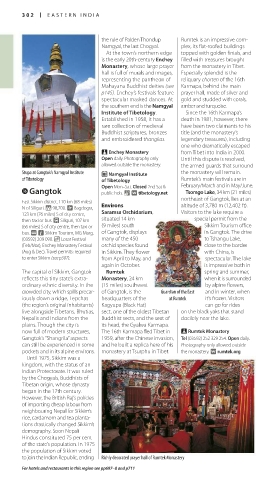
Stupa at Gangtok’s Namgyal Institute E Namgyal Institute the monastery will remain.
of Tibetology of Tibetology Rumtek’s main festivals are in
Open Mon–Sat. Closed 2nd Sat & February/March and in May/June.
y Gangtok public hols. & ∑ tibetology.net Tsomgo Lake, 34 km (21 miles)
northeast of Gangtok, lies at an
East Sikkim district. 110 km (68 miles)
N of Siliguri. * 98,700. ~ Bagdogra, Environs altitude of 3,780 m (12,402 ft).
123 km (76 miles) S of city centre, Saramsa Orchidarium, Visitors to the lake require a
then taxi or bus. £ Siliguri, 107 km situated 14 km special permit from the
(66 miles) S of city centre, then taxi or (9 miles) south Sikkim Tourism office
bus. @ n Sikkim Tourism, MG Marg, of Gangtok, displays in Gangtok. The drive
(03592) 209 090. _ Losar Festival many of the 450 to Tshangu Lake,
(Feb/Mar), Enchey Monastery Festival orchid species found close to the border
(Aug & Dec). Travel permits: required in Sikkim. They flower with China, is
to enter Sikkim (see p307). from April to May, and spectacular. The lake
again in October. is impressive both in
The capital of Sikkim, Gangtok Rumtek spring and summer,
reflects this tiny state’s extra Monastery, 24 km when it is surrounded
ordinary ethnic diversity. In the (15 miles) southwest by alpine flowers,
crowded city, which spills precar of Gangtok, is the Guardian of the East and in winter, when
iously down a ridge, Lepchas headquarters of the at Rumtek it’s frozen. Visitors
(the region’s original inhabitants) Kagyupa (Black Hat) can go for rides
live alongside Tibetans, Bhutias, sect, one of the oldest Tibetan on the black yaks that stand
Nepalis and Indians from the Buddhist sects, and the seat of docilely near the lake.
plains. Though the city is its head, the Gyalwa Karmapa.
now full of modern structures, The 16th Karmapa fled Tibet in Rumtek Monastery
Gangtok’s “Shangrila” aspects 1959, after the Chinese invasion, Tel (03592) 252 329 254. Open daily.
can still be experienced in some and he built a replica here of his Photography only allowed outside
pockets and in its alpine environs. monastery at Tsurphu in Tibet. the monastery. ∑ rumtek.org
Until 1975, Sikkim was a
kingdom, with the status of an
Indian Protectorate. It was ruled
by the Chogyals, Buddhists of
Tibetan origin, whose dynasty
began in the 17th century.
However, the British Raj’s policies
of importing cheap labour from
neighbouring Nepal for Sikkim’s
rice, cardamom and tea plan ta
tions drastically changed Sikkim’s
demography. Soon Nepali
Hindus constituted 75 per cent
of the state’s population. In 1975
the population of Sikkim voted
to join the Indian Republic, ending Richly decorated prayer hall of Rumtek Monastery
For hotels and restaurants in this region see pp697–8 and p711
302-303_EW_India.indd 302 26/04/17 11:45 am
Eyewitness Travel LAYERS PRINTED:
Catalogue template “UK” LAYER
(Source v2.6)
Date 12th July 2013
Size 125mm x 217mm

