


Page 314 - (DK Eyewitness) Travel Guide - India
P. 314
312 EASTERN INDIA
Exploring Bhubaneswar’s like a tiger’s head with the
Surroundings mouth open. The most
significant cave historically is
Hathi Gumpha or “Elephant
Many sites of historical and architectural significance Cave” (Cave 14). On the rock
lie close to Bhubaneswar. They include Jain monastic above its entrance is an
caves, Hindu temples, Buddhist stupas and ancient rock inscription from the 1st century
inscriptions, dotting the lush green landscape around the BC. It records that the caves
city. Dating from the 3rd century BC (when the area was part were carved by Kharavela, third
of the great kingdom of Kalinga) to the 13th century AD, king of the powerful Chedi
dynasty, whose conquests
these sites bear witness to the region’s political and religious included large parts of Bihar,
importance for a continuous period of over 1,000 years. the Deccan and South India.
The inscription also states
that King Kharavela rebuilt his
capital, Kalinganagar, after it was
destroyed by a cyclone. Even
today, Odisha remains vulnerable
to cyclones, the last one having
devastated the state in October
1999. On the summit of Udaigiri
stands a ruined apsidal structure,
probably used as a place of
worship by the monks.
Across the highway, on
Khandagiri, are 15 caves with
carvings of sacred Jain symbols.
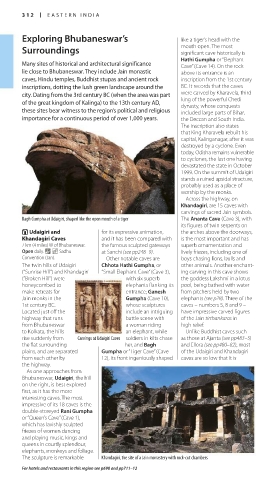
Bagh Gumpha at Udaigiri, shaped like the open mouth of a tiger The Ananta Cave (Cave 3), with
its figures of twin serpents on
T Udaigiri and for its expressive animation, the arches above the doorways,
Khandagiri Caves and it has been compared with is the most important and has
7 km (4 miles) W of Bhubaneswar. the famous sculpted gateways superb ornamentation and
Open daily. & _ Sadhu at Sanchi (see pp248–9). lively friezes, including one of
Convention (Jan). Other notable caves are boys chasing lions, bulls and
The twin hills of Udaigiri Chhota Hathi Gumpha, or other animals. Another enchant
(“Sunrise Hill”) and Khandagiri “Small Elephant Cave” (Cave 3), ing carving in this cave shows
(“Broken Hill”) were with six superb the goddess Lakshmi in a lotus
honeycombed to elephants flanking its pool, being bathed with water
make retreats for entrance; Ganesh from pitchers held by two
Jain monks in the Gumpha (Cave 10), elephants (see p28). Three of the
1st century BC. whose sculptures caves – numbers 5, 8 and 9 –
Located just off the include an intriguing have impressive carved figures
highway that runs battle scene with of the Jain tirthan karas in
from Bhubaneswar a woman riding high relief.
to Kolkata, the hills an elephant, while Unlike Buddhist caves such
rise suddenly from Carvings at Udaigiri Caves soldiers in kilts chase as those at Ajanta (see pp483–5)
the flat surrounding her, and Bagh and Ellora (see pp480–82), most
plains, and are separated Gumpha or “Tiger Cave” (Cave of the Udaigiri and Khandagiri
from each other by 12), its front ingeniously shaped caves are so low that it is
the highway.
As one approaches from
Bhubaneswar, Udaigiri, the hill
on the right, is best explored
first, as it has the more
interesting caves. The most
impressive of its 18 caves is the
doublestoreyed Rani Gumpha
or “Queen’s Cave” (Cave 1),
which has lavishly sculpted
friezes of women dancing
and playing music, kings and
queens in courtly splendour,
elephants, monkeys and foliage.
The sculpture is remarkable Khandagiri, the site of a Jain monastery with rock-cut chambers
For hotels and restaurants in this region see p698 and pp711–12
312-313_EW_India.indd 312 26/04/17 11:45 am
Eyewitness Travel LAYERS PRINTED:
Catalogue template “UK” LAYER
(Source v2.6)
Date 12th July 2013
Size 125mm x 217mm

