


Page 315 - (DK Eyewitness) Travel Guide - India
P. 315
ODISHA 313
Festivals of Odisha
Tribal Mela (Jan),
Bhubaneswar. Odisha’s large
and varied tribal population
exhibit their dances, music,
arts and crafts at this colourful
week-long festival
Makar Mela (14 Jan), Chilika
Lake. Pilgrims bring offerings to
a cave and temple devoted
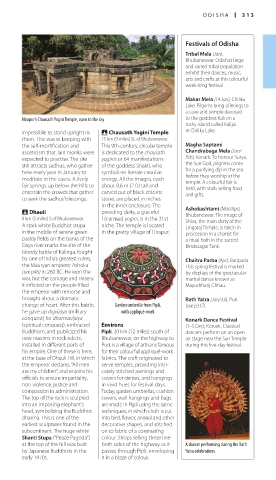
Hirapur’s Chausath Yogini Temple, open to the sky to the goddess Kali on a
rocky island called Kalijai
impossible to stand upright in Chausath Yogini Temple in Chilika Lake.
them. This was in keeping with 15 km (9 miles) SE of Bhubaneswar.
the self-mortification and This 9th-century, circular temple Magha Saptami
asceticism that Jain monks were is dedicated to the chausath Chandrabaga Mela (Jan/
expected to practise. The site yoginis or 64 manifestations Feb), Konark. To honour Surya,
still attracts sadhus, who gather of the goddess Shakti, who the Sun God, pilgrims come
here every year in January to symbolizes female creative for a purifying dip in the sea
meditate in the caves. A lively energy. All the images, each before they worship at the
temple. A colourful fair is
fair springs up below the hills to about 0.6 m (2 ft) tall and held, with stalls selling food
entertain the crowds that gather carved out of black chlorite and gifts.
to seek the sadhus’ blessings. stone, are placed in niches
in the inner enclosure. The
Dhauli presiding deity, a graceful Ashokashtami (Mar/Apr),
Bhubaneswar. The image of
8 km (5 miles) S of Bhubaneswar. 10-armed yogini, is in the 31st Shiva, the main deity of the
A stark white Buddhist stupa niche. The temple is located Lingaraj Temple, is taken in
in the middle of serene green in the pretty village of Hirapur. pro cession in a chariot for
paddy fields on the banks of the a ritual bath in the sacred
Daya river marks the site of the Bindusagar Tank.
bloody battle of Kalinga, fought
by one of India’s greatest rulers, Chaitra Parba (Apr), Baripada.
the Mauryan emperor Ashoka This spring festival is marked
(see p46) in 260 BC. He won the by displays of the spectacular
war, but the carnage and misery martial dance known as
it inflicted on the people filled Mayurbhanj Chhau.
the emperor with remorse and
brought about a dramatic Rath Yatra (Jun/Jul), Puri
change of heart. After this battle, Garden umbrella from Pipli, (see p317).
he gave up digvijaya (military with appliqué-work
conquest) for dharmavijaya Konark Dance Festival
(spiritual conquest), embraced Environs (1–5 Dec), Konark. Classical
Buddhism, and publicized his Pipli, 20 km (12 miles) south of dancers perform on an open
new maxims in rock edicts, Bhubaneswar, on the highway to air stage near the Sun Temple
installed in different parts of Puri, is a village of artisans famous during this five-day festival.
his empire. One of these is here, for their colourful appliqué-work
at the base of Dhauli Hill, in which fabrics. The craft originated to
the emperor declares, “All men serve temples, providing intri-
are my children”, and enjoins his cately stitched awnings and
officials to ensure impartiality, covers for deities, and hangings
non-violence, justice and in vivid hues for festival days.
compassion in administration. Today, garden umbrellas, cushion
The top of the rock is sculpted covers, wall hangings and bags
into an imposing elephant’s are made in Pipli using the same
head, symbolizing the Buddhist techniques, in which cloth is cut
dharma. This is one of the into bird, flower, animal and other
earliest sculptures found in the decorative shapes, and stitched
subcontinent. The huge white on to fabric of a contrasting
Shanti Stupa (“Peace Pagoda”) colour. Shops selling these line
at the top of the hill was built both sides of the highway as it A dancer performing during the Rath
by Japanese Buddhists in the passes through Pipli, enveloping Yatra celebrations
early 1970s. it in a blaze of colour.
312-313_EW_India.indd 313 26/04/17 11:45 am

