


Page 324 - (DK Eyewitness) Travel Guide - India
P. 324
322 EASTERN INDIA
8 Cuttack remain of this great citadel, 9 Ratnagiri
which once had a nine-
Cuttack district. 35 km (22 miles) Cuttack district. 70 km (43 miles)
N of Bhubaneswar. * 535,150. storeyed palace. NE of Cuttack. @ n Odisha Tourism,
£ @ n Odisha Tourism, Arunodaya The eastern part of town is Link Rd, Cuttack, (0671) 231 2225.
Market Building, Link Rd, (0671) 231 more interesting, with silver-
2225. _ Bali Yatra (Oct/Nov). smiths’ shops in Balu Bazaar The three Buddhist sites of
and Nayasarak, where Cuttack’s Ratnagiri, Udaigiri and Lalitgiri,
Situated on the Mahanadi famous silver filigree jewellery situated close to each other, are
Delta, Cuttack is Odisha’s most is made. Nearby, in the shops most conveniently visited on
populous city, and was its on Jail Road, the full range of a day trip from Cuttack or
capital from the 10th century Odisha’s beautiful handicrafts Bhubaneswar, driving through a
onwards until 1956, when are available, including ikat silk, beautiful landscape of low hills
the capital was moved to carved hornware and paintings. and lush paddy fields. The most
Bhubaneswar (see pp310–13). In this area, a cluster of impressive of the three sites is
There is little evidence today of green domes marks the Ratnagiri (“Hill of Jewels”), which,
the city’s historic past. The 18th-century Kadam Rasul between the 7th and the 11th
gateway and moat of the Mosque, where the Prophet centuries, was a major Buddhist
13th-century Barabati Fort, in Mohammed’s footprints are university and monastic
northwest Cuttack, are all that carved on a round stone. establishment, described by the
7th-century Chinese traveller
Hiuen Tsang (see p223). Located
on top of a mound, crowned by
a large stupa, the best-preserved
structure here is a monastery
with a central courtyard and an
impressive colonnade around
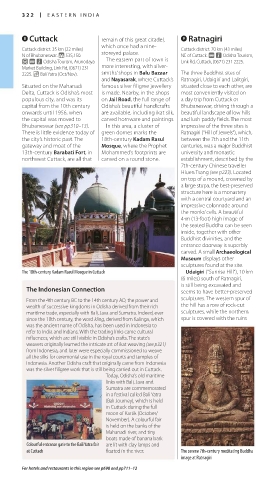
the monks’ cells. A beautiful
4-m (13-foot) high image of
the seated Buddha can be seen
inside, together with other
Buddhist divinities, and the
entrance doorway is superbly
carved. A small Archaeological
Museum displays other
sculptures found at the site.
The 18th-century Kadam Rasul Mosque in Cuttack Udaigiri (“Sunrise Hill”), 10 km
(6 miles) south of Ratnagiri,
is still being excavated and
The Indonesian Connection seems to have better-preserved
From the 4th century BC to the 14th century AD, the power and sculptures. The western spur of
wealth of successive kingdoms in Odisha derived from their rich the hill has a row of rock-cut
maritime trade, especially with Bali, Java and Sumatra. Indeed, ever sculptures, while the northern
since the 10th century, the word kling, derived from Kalinga, which spur is covered with the ruins
was the ancient name of Odisha, has been used in Indonesia to
refer to India and Indians. With the trading links came cultural
influences, which are still visible in Odisha’s crafts. The state’s
weavers originally learned the intricate art of ikat weaving (see p321)
from Indonesia, and later were especially commissioned to weave
all the silks for ceremonial use in the royal courts and temples of
Indonesia. Another Odisha craft that originally came from Indonesia
was the silver filigree work that is still being carried out in Cuttack.
Today, Odisha’s old maritime
links with Bali, Java and
Sumatra are commem orated
in a festival called Bali Yatra
(Bali Journey), which is held
in Cuttack during the full
moon of Kartik (October/
November). A colourful fair
is held on the banks of the
Mahanadi river, and tiny
boats made of banana bark
Colourful entrance gate to the Bali Yatra fair are lit with clay lamps and
at Cuttack floated in the river. The serene 7th-century meditating Buddha
image at Ratnagiri
For hotels and restaurants in this region see p698 and pp711–12
322-323_EW_India.indd 322 26/04/17 11:45 am
Eyewitness Travel LAYERS PRINTED:
Catalogue template “UK” LAYER
(Source v2.6)
Date 12th July 2013
Size 125mm x 217mm

