


Page 323 - (DK Eyewitness) Travel Guide - India
P. 323
ODISHA 321
The Odisha Weaver’s Art
Odisha has a long and rich tradition of handwoven textiles. Over 300,000 people work in
the state’s textile industry producing a range of materials, from the simple cotton weaves
of tribal areas, to the elaborate painted textiles for use in temples. Odisha’s forests yield a
wealth of wild silk cocoons, which are now supplemented by mulberry plantations. The
state is famous for its silk ikat weaves, an intricate technique in which warp and weft
threads are tie-dyed in such a way as to produce patterns when woven. Typical motifs
include birds, animals, fish, seashells, holy rudraksh beads and temple spires.
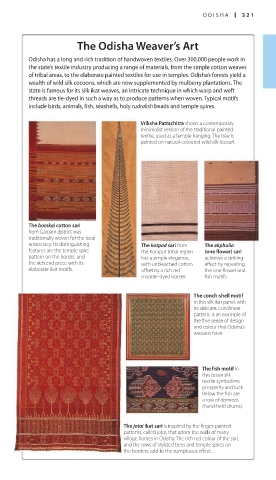
Vriksha Pattachitra shows a contemporary
minimalist version of the traditional painted
textile, used as a temple hanging. The tree is
painted on natural-coloured wild silk (tussar).
The bomkai cotton sari
from Ganjam district was
traditionally woven for the local
aristocracy. Its distinguishing The kotpad sari from The ekphulia
features are the temple spire the Koraput tribal region (one flower) sari
pattern on the border, and has a simple elegance, achieves a striking
the rich end piece with its with unbleached cotton effect by repeating
elaborate ikat motifs. offset by a rich red the one-flower and
madder-dyed border. fish motifs.
The conch-shell motif
in this silk ikat panel, with
its delicate, curvilinear
pattern, is an example of
the fine sense of design
and colour that Odisha’s
weavers have.
The fish motif in
this tussar silk
textile symbolizes
prosperity and luck.
Below the fish are
a row of damroos
(hand-held drums).
The jotai ikat sari is inspired by the finger-painted
patterns, called jotai, that adorn the walls of many
village homes in Odisha. The rich red colour of the sari,
and the rows of stylized trees and temple spires on
the borders, add to the sumptuous effect.
320-321_EW_India.indd 321 26/04/17 11:45 am

