


Page 327 - (DK Eyewitness) Travel Guide - India
P. 327
ODISHA 325
accommodation are available
in forest rest houses at Lulung,
Barehipani, Chahala, Joranda
and Nawana.
Environs
The capital of the Bhanja kings
in the 10th and 11th centuries,
Khiching has some of the finest
examples of temple sculpture
to be seen in Odisha. It is 20 km
(12 miles) west of Jashipur, the
western entry point to Simlipal
National Park, and 150 km
(93 miles) west of Baripada. The
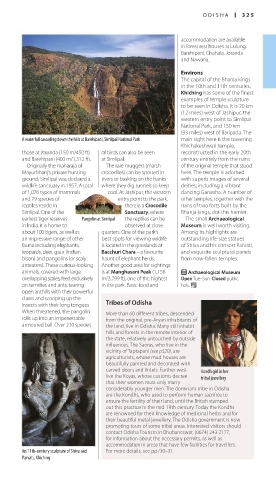
A waterfall cascading down the hills at Barehipani, Simlipal National Park main sight here is the towering
Khichakeshwari temple,
those at Joranda (150 m/492 ft) of birds can also be seen reconstructed in the early 20th
and Barehipani (400 m/1,312 ft). at Simlipal. century entirely from the ruins
Originally the maharaja of The rare muggers (marsh of the original temple that stood
Mayurbhanj’s private hunting crocodiles) can be spotted in here. The temple is adorned
ground, Simlipal was declared a rivers or basking on the banks with superb images of several
wildlife sanctuary in 1957. A total where they dig tunnels to keep deities, including a vibrant
of 1,076 types of mammals cool. At Jashipur, the western dancing Ganesha. A number of
and 29 species of entry point to the park, other temples, together with the
reptiles reside in there is a Crocodile ruins of two forts built by the
Simlipal. One of the Sanc tuary, where Bhanja kings, dot this hamlet.
earliest tiger reserves Pangolin at Simlipal the reptiles can be The small Archaeological
in India, it is home to observed at close Museum is well worth visiting.
about 100 tigers, as well as quarters. One of the park’s Among its highlights are
an impressive range of other best spots for viewing wildlife outstanding life-size statues
fauna including elephants, is located in the grasslands at of Shiva and his consort Parvati,
leopards, deer, gaur (Indian Bacchuri Chara – a favourite and exquisite sculptural panels
bison) and pangolins (or scaly haunt of elephant herds. from now-fallen temples.
anteaters). These curious-looking Another good area for sightings
animals, covered with large is at Manghasani Peak (1,158 E Archaeological Museum
overlapping scales, feed exclusively m/3,799 ft), one of the highest Open Tue–Sun. Closed public
on termites and ants, tearing in the park. Basic food and hols. &
open anthills with their powerful
claws and scooping up the
insects with their long tongues. Tribes of Odisha
When threatened, the pangolin More than 60 different tribes, descended
rolls up into an impenetrable from the original, pre-Aryan inhabitants of
armoured ball. Over 230 species the land, live in Odisha. Many still inhabit
hills and forests in the remote interior of
the state, relatively untouched by outside
influences. The Saoras, who live in the
vicinity of Taptapani (see p320), are
agriculturists, whose mud houses are
beautifully painted and decorated with
carved doors and lintels. Further west Kondh girl in her
live the Koyas, whose customs decree tribal jewellery
that their women must only marry
considerably younger men. The dominant tribe in Odisha
are the Kondhs, who used to perform human sacrifice to
ensure the fertility of their land, until the British stamped
out this practice in the mid-19th century. Today the Kondhs
are renowned for their knowledge of medicinal herbs and for
their beautiful metal jewellery. The Odisha government is now
promoting tours of some tribal areas. Interested visitors should
contact Odisha Tourism in Bhubaneswar, (0674) 243 2177,
for information about the necessary permits, as well as
accommodation in areas that have few facilities for travellers.
An 11th-century sculpture of Shiva and For more details, see pp730–31.
Parvati, Khiching
324-325_EW_India.indd 325 26/04/17 11:45 am

