


Page 331 - (DK Eyewitness) Travel Guide - India
P. 331
ASSA M & THE NOR THEAST 329
villages, a comprehensive
collection of local handicrafts
and a gallery of medieval stone
and bronze sculptures, which
were excavated from Ambari,
an archaeological site in the
heart of the city.
O Zoo & Botanical Gardens
RG Baruah Rd. Tel (0361) 220 1363.
Open 7am–4:30pm Mon–Thu.
& Extra charges for photography.
The well-maintained zoo is in the
eastern part of the city. Clouded
leopards, hornbills and, of course,
the native one-horned rhinos,
can be seen in spacious, moated
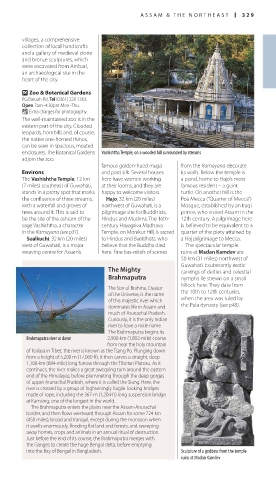
enclosures. The Botanical Gardens Vashishtha Temple, on a wooded hill surrounded by streams
adjoin the zoo.
famous golden-hued muga from the Ramayana decorate
Environs and paat silk. Several houses its walls. Below the temple is
The Vashishtha Temple, 12 km here have women working a pond, home to Hajo’s most
(7 miles) southeast of Guwahati, at their looms, and they are famous resident – a giant
stands in a pretty spot that marks happy to welcome visitors. turtle. On another hill is the
the confluence of three streams, Hajo, 32 km (20 miles) Poa Mecca (“Quarter of Mecca”)
with a waterfall and groves of northwest of Guwahati, is a Mosque, established by an Iraqi
trees around it. This is said to pilgrimage site for Buddhists, prince, who visited Assam in the
be the site of the ashram of the Hindus and Muslims. The 16th- 12th century. A pilgrimage here
sage Vashishtha, a character century Hayagriva Madhava is believed to be equivalent to a
in the Ramayana (see p31). Temple, on Monikut Hill, is sacred quarter of the piety attained by
Sualkuchi, 32 km (20 miles) to Hindus and Buddhists, who a Haj pilgrimage to Mecca.
west of Guwahati, is a major believe that the Buddha died The spectacular temple
weaving centre for Assam’s here. Fine bas-reliefs of scenes ruins at Madan Kamdev are
50 km (31 miles) northwest of
Guwahati. Exuberantly erotic
The Mighty carvings of deities and celestial
Brahmaputra nymphs lie strewn on a small
hillock here. They date from
The Son of Brahma, Creator
of the Universe, is the name the 10th to 12th centuries,
of this majestic river which when the area was ruled by
dominates life in Assam and the Pala dynasty (see p48).
much of Arunachal Pradesh.
Curiously, it is the only Indian
river to have a male name.
The Brahmaputra begins its
Brahmaputra river at dawn 2,900-km (1,802-mile) course
from near the holy mountain
of Kailasa in Tibet, the river is known as the Tsang Po. Plunging down
from a height of 5,200 m (17,060 ft), it then carves a straight, deep
1,100-km (684-mile) long furrow through the Tibetan Plateau. As it
continues, the river makes a great sweeping turn around the eastern
end of the Himalayas, before plummeting through the deep gorges
of upper Arunachal Pradesh, where it is called the Siang. Here, the
river is crossed by a group of frighteningly fragile-looking bridges
made of rope, including the 367-m (1,204-ft) long suspension bridge
at Kamsing, one of the longest in the world.
The Brahmaputra enters the plains near the Assam-Arunachal
border, and then flows westward through Assam for some 724 km
(450 miles), broad and tranquil, except during the monsoon when
it swells enormously, flooding flat land and forests, and sweeping
away homes, crops and animals in an annual ritual of destruction.
Just before the end of its course, the Brahmaputra merges with
the Ganges to create the huge Bengal delta, before emptying
into the Bay of Bengal in Bangladesh. Sculpture of a goddess from the temple
ruins at Madan Kamdev
328-329_EW_India.indd 329 26/04/17 11:45 am

