


Page 36 - (DK Eyewitness) Travel Guide - India
P. 36
34 INTRODUCING INDIA
Traditional Indian Attire
One of the most remarkable features of Indian apparel is the
ingenious way in which a simple length of unstitched cloth
is used. Gracefully draped as a sari, or wrapped around the
head as a turban, the length of fabric is versatile, and is worn
by both men and women. Stitched garments include the
kurta, pyjama, sherwani, the voluminous skirt (ghaghara or
lehenga), and of course, the trouser, shirt and ubiquitous blue
jeans. Today, despite the growing influence of contemporary
Western fashion trends, most Indians continue to dress
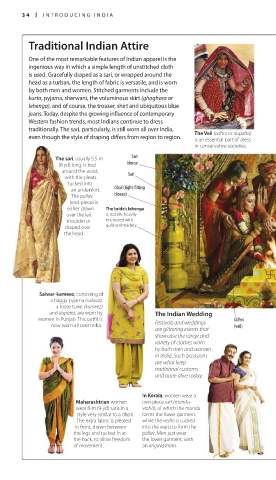
traditionally. The sari, particularly, is still worn all over India, The Veil (odhni or dupatta)
even though the style of draping differs from region to region. is an essential part of dress
in conservative societies.
The sari, usually 5.5 m Sari
(6 yd) long, is tied blouse
around the waist, Sari
with the pleats
tucked into
an underskirt. Choli (tight-fitting
The pallav blouse)
(end-piece) is
either drawn The bride’s lehenga
over the left is red silk, heavily
shoulder or encrusted with
draped over gold embroidery.
the head.
Salwar-kameez, consisting of
a baggy pyjama (salwar),
a loose tunic (kameez)
and dupatta, are worn by The Indian Wedding
women in Punjab. This outfit is Odhni
now worn all over India. Festivals and weddings (veil)
are glittering events that
showcase the range and
variety of clothes worn
by both men and women
in India. Such occasions
are what keep
traditional customs
and attire alive today.
In Kerala, women wear a
Maharashtrian women two-piece sari (mundu-
wear 8-m (9-yd) saris in a veshti), of which the mundu
style very similar to a dhoti. forms the lower garment,
The extra fabric is pleated while the veshti is tucked
in front, drawn bet ween into the waist to form the
the legs and tucked in at pallav. Men just wear
the back, to allow freedom the lower garment, with
of movement. an angavastram.
034-035_EW_India.indd 34 26/04/17 11:52 am

