


Page 37 - (DK Eyewitness) Travel Guide - India
P. 37
A POR TR AIT OF INDIA 35
Headdresses
For Indian men, the most important accessory is the turban (pagri or
safa), an unstitched length of cloth that is deftly tied
around the head. More than just a fashion statement,
the turban’s style and colour also indicate the wearer’s
social, religious, caste and regional status. Rajasthani
turbans are intrinsic to the cultural ethos of the land,
whereas in Punjab, the Sikh turban is characteristic of
their identity as a martial community (see p107). From
the mid-19th century onwards, topis (caps) became
popular, especially among courtiers in the Muslim
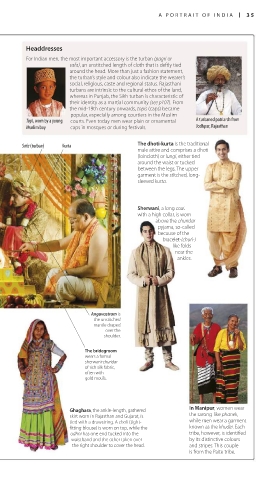
Topi, worn by a young courts. Even today men wear plain or ornamental A turbaned patriarch from
Muslim boy caps in mosques or during festivals. Jodhpur, Rajasthan
Safa (turban) Kurta The dhoti-kurta is the traditional
male attire and comprises a dhoti
(loincloth) or lungi, either tied
around the waist or tucked
between the legs. The upper
garment is the stitched, long-
sleeved kurta.
Sherwani, a long coat
with a high collar, is worn
above the churidar
pyjama, so-called
because of the
bracelet-(churi-)
like folds
near the
ankles.
Angavastram is
the unstitched
mantle draped
over the
shoulder.
The bridegroom
wears a formal
sherwani-churidar
of rich silk fabric,
often with
gold motifs.
Ghaghara, the ankle-length, gathered In Manipur, women wear
skirt worn in Rajasthan and Gujarat, is the sarong-like phanek,
tied with a drawstring. A choli (tight- while men wear a garment
fitting blouse) is worn on top, while the known as the khudei. Each
odhni has one end tucked into the tribe, however, is identified
waistband and the other taken over by its distinctive colours
the right shoulder to cover the head. and stripes. This couple
is from the Paite tribe.
034-035_EW_India.indd 35 26/04/17 11:52 am

