


Page 34 - (DK Eyewitness) Travel Guide - India
P. 34
32 INTRODUCING INDIA
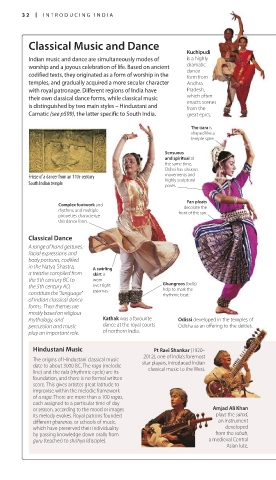
Classical Music and Dance
Kuchipudi
Indian music and dance are simultaneously modes of is a highly
worship and a joyous celebration of life. Based on ancient dramatic
dance
codified texts, they originated as a form of worship in the form from
temples, and gradually acquired a more secular character Andhra
with royal patronage. Different regions of India have Pradesh,
their own classical dance forms, while classical music which often
enacts scenes
is distinguished by two main styles – Hindustani and from the
Carnatic (see p599), the latter specific to South India. great epics.
The tiara is
shaped like a
temple spire.
Sensuous
and spiritual at
the same time,
Odissi has sinuous
Frieze of a dancer from an 11th-century movements and
highly sculptural
South Indian temple poses.
Fan pleats
Complex footwork and
rhythms, and multiple decorate the
pirouettes characterize front of the sari.
this dance form.
Classical Dance
A range of hand gestures,
facial expres sions and
body postures, codified
in the Natya Shastra, A swirling
a treatise compiled from skirt is
the 5th century BC to worn
the 5th century AD, over tight Ghungroos (bells)
help to mark the
pyjamas.
constitute the “language” rhythmic beat.
of Indian classical dance
forms. Their themes are
mostly based on religious
myth ology, and Kathak was a favourite Odissi developed in the temples of
percussion and music dance at the royal courts Odisha as an offering to the deities.
play an important role. of northern India.
Hindustani Music Pt Ravi Shankar (1920–
2012), one of India’s foremost
The origins of Hindustani classical music sitar players, introduced Indian
date to about 3000 BC. The raga (melodic classical music to the West.
line) and the tala (rhythmic cycle) are its
foundation, and there is no formal written
score. This gives artistes great latitude to
improvise within the melodic framework
of a raga. There are more than a 100 ragas,
each assigned to a particular time of day
or season, according to the mood or images Amjad Ali Khan
its melody evokes. Royal patrons founded plays the sarod,
different gharanas, or schools of music, an instrument
which have preserved their individuality developed
by passing knowledge down orally from from the rubab,
guru (teacher) to shishya (disciple). a medieval Central
Asian lute.
032-033_EW_India.indd 32 26/04/17 11:42 am
Eyewitness Travel LAYERS PRINTED:
Feature template “UK” LAYER
(SourceReport v1.3)
Date 18th October 2012
Size 125mm x 217mm

