


Page 378 - (DK Eyewitness) Travel Guide - India
P. 378
376 WESTERN INDIA
8 Shekhawati
Sikar & Jhunjhunu districts. 115 km
(71 miles) NW from Jaipur to Sikar.
@ _ Gangaur Festival (Mar/Apr),
Dussehra (Sept/Oct).
This region, named after its
15th-century ruler Rao Shekha,
has a number of fascinating
small towns with well-preserved
painted havelis, forts and temples.
Among the most interesting are
Lachhmangarh and Fatehpur
with their grand havelis, and
Dundlod, with its well-restored
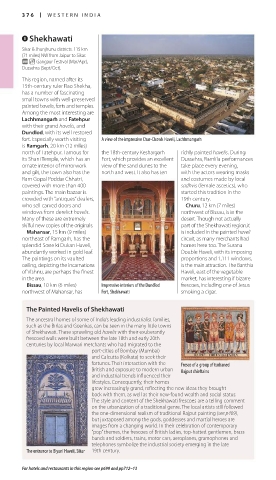
fort. Especially worth visiting A view of the impressive Char-Chowk Haveli, Lachhmangarh
is Ramgarh, 20 km (12 miles)
north of Fatehpur. Famous for the 18th-century Keshargarh richly painted havelis. During
its Shani Temple, which has an Fort, which provides an excellent Dussehra, Ramlila performances
ornate interior of mirrorwork view of the sand dunes to the take place every even ing,
and gilt, the town also has the north and west. It also has ten with the actors wearing masks
Ram Gopal Poddar Chhatri, and costumes made by local
covered with more than 400 sadhvis (female ascetics), who
paintings. The main bazaar is started this tradition in the
crowded with “antiques” dealers, 19th century.
who sell carved doors and Churu, 12 km (7 miles)
windows from derelict havelis. northwest of Bissau, is in the
Many of these are extremely desert. Though not actually
skilful new copies of the originals. part of the Shekhawati region,it
Mahansar, 15 km (9 miles) is included in the painted haveli
northeast of Ramgarh, has the circuit, as many merchants had
splendid Sone ki Dukan Haveli, homes here too. The Surana
abundantly worked in gold leaf. Double Haveli, with its imposing
The paintings on its vaulted proportions and 1,111 windows,
ceiling, depicting the incarnations is the main attraction. The Banthia
of Vishnu, are perhaps the finest Haveli, east of the vegetable
in the area. market, has interesting if bizarre
Bissau, 10 km (6 miles) Impressive interiors of the Dundlod frescoes, including one of Jesus
northwest of Mahansar, has Fort, Shekhawati smoking a cigar.
The Painted Havelis of Shekhawati
The ancestral homes of some of India’s leading industrialist families,
such as the Birlas and Goenkas, can be seen in the many little towns
of Shekhawati. These sprawling old havelis with their exuberantly
frescoed walls were built between the late 18th and early 20th
centuries by local Marwari merchants who had migrated to the
port-cities of Bombay (Mumbai)
and Calcutta (Kolkata) to seek their
fortunes. Their interaction with the Fresco of a group of turbaned
British and exposure to modern urban Rajput chieftains
and industrial trends influenced their
lifestyles. Consequently, their homes
grew increasingly grand, reflecting the new ideas they brought
back with them, as well as their new-found wealth and social status.
The style and content of the Shekhawati frescoes are a telling comment
on the urbanization of a traditional genre. The local artists still followed
the one-dimensional realism of traditional Rajput painting (see p409),
but juxtaposed among the gods, goddesses and martial heroes are
images from a changing world. In their celebration of contemporary
“pop” themes, the frescoes of British ladies, top-hatted gentlemen, brass
bands and soldiers, trains, motor cars, aeroplanes, gramophones and
telephones symbolize the industrial society emerging in the late
The entrance to Biyani Haveli, Sikar 19th century.
For hotels and restaurants in this region see p699 and pp712–13
376-377_EW_India.indd 376 26/04/17 11:54 am

