


Page 383 - (DK Eyewitness) Travel Guide - India
P. 383
R A JASTHAN 381
Ships of the Thar Desert
The desert dwellers of Rajasthan could not survive without their camels. In the sandy,
inhospitable expanse of the Thar Desert, this animal is their only means of transport,
their beast of burden, as well as an important source of nourishment (camel’s milk,
slightly salty in taste, is drunk throughout Rajasthan’s deserts). The hardy camel
demands little in return. It can do without food and water for up to a month in winter,
and a week in summer, tanking up on 70 litres (123 pints) of water at one go. The
Rajasthani’s affection for his camel is evident at all the desert fairs, where camels
are given pride of place, resplendent in their colourful tassels and jewellery.
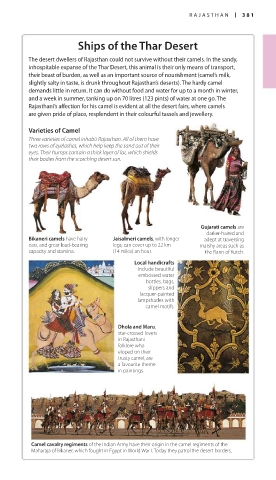
Varieties of Camel
Three varieties of camel inhabit Rajasthan. All of them have
two rows of eyelashes, which help keep the sand out of their
eyes. Their humps contain a thick layer of fat, which shields
their bodies from the scorching desert sun.
Gujarati camels are
darker-haired and
Bikaneri camels have hairy Jaisalmeri camels, with longer adept at traversing
ears, and great load-bearing legs, can cover up to 22 km marshy areas such as
capacity and stamina. (14 miles) an hour. the Rann of Kutch.
Local handicrafts
include beautiful
embossed water
bottles, bags,
slippers and
lacquer-painted
lampshades with
camel motifs.
Dhola and Maru,
star-crossed lovers
in Rajasthani
folklore who
eloped on their
trusty camel, are
a favourite theme
in paintings.
Camel cavalry regiments of the Indian Army have their origin in the camel regiments of the
Maharaja of Bikaner, which fought in Egypt in World War I. Today they patrol the desert borders.
380-381_EW_India.indd 381 26/04/17 11:54 am

