


Page 385 - (DK Eyewitness) Travel Guide - India
P. 385
R A JASTHAN 383
irrigation water to his kingdom. of the most ornate are the number of migratory birds.
He was also famous for hosting Rampuria and Kothari havelis. The 17th-century Karni Mata
elaborate shikars (hunting The former is now a delightful Temple at Deshnok, 30 km
expeditions) for visiting British heritage hotel. In the (19 miles) southeast of Bikaner,
dignitaries. The Durbar southwestern corner of the is also known as the Rat Temple,
Niwas now houses the walled town are two Jain because of the hundreds of rats
fort museum, whose temples, dating from that swarm around the temple
armoury section the early 16th century, and its precincts. The rats are
includes such the Bhandeshwar considered sacred and are fed
fascinating exhibits and Sandeshwar sweets and milk by the priests
as a 56-kg (123-lb) temples. Both are and visitors, who believe that
suit of armour, a ornately carved and they are reincarnated holy men.
dagger with a pistol are embellished with The temple is dedicated to Karni
built into it, and frescoes, mirrorwork Mata, an incarnation of Durga,
swords with lion- Coat of arms of and gold-leaf scroll- and is entered through intricately
shaped handles. Other Bikaner’s rulers work inside. They carved silver doors, presented
exhibits include the were built by two by Sir Ganga.
rulers’ fragrant sandalwood brothers who, having no
throne, said to date back to children, constructed these O Camel Breeding Farm
their 5th-century ancestors, masterpieces for posterity. Open Mon–Sat. ^ &
who were the kings of Kannauj Karni Mata Temple
(Uttar Pradesh), and a curious P Lalgarh Palace Open daily. _ Karni Mata Festival
half-spoon for soup, used by N of city centre. Tel (0151) 254 0201. (Mar/Apr & Sep/Oct).
the maharaja to ensure that his Museum: Open Thu–Tue. & ^
luxuriant moustache remained Lalgarh Palace, outside the
pristine during mealtimes. walled town, is a sprawling
extravaganza of carved friezes,
P Walled City jalis, pillars and arches in the
West end of MG Rd. Shops: Open daily. distinctive reddish-pink local
In the old walled city, entered sandstone (which resulted in
through Kote Gate, is the bazaar, Bikaner being dubbed the
where excellent local handicrafts “Red City”). Constructed
can be found, such as rugs and between 1902 and 1926,
carpets, painted lampshades it was designed by Sir Samuel
made of camel hide, and beautiful Swinton Jacob (see p357) in a
miniatures in the Bikaneri style, style that combines traditional
can be found. Savoury snacks Rajput and Renaissance
(bhujias) are another local European features with Art
speciality, and Bikaneri bhujias Nouveau decor inside. Part
are renowned throughout India, of it has been converted into
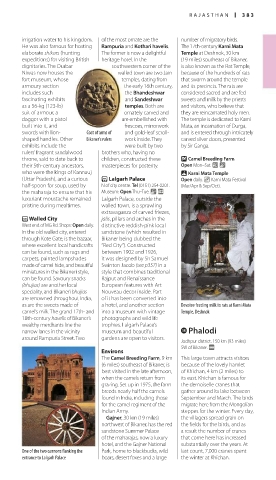
as are the sweets made of a hotel, and another section Devotee feeding milk to rats at Karni Mata
camel’s milk. The grand 17th- and into a museum with vintage Temple, Deshnok
18th-cen tury havelis of Bikaner’s photo graphs and wildlife
wealthy merchants line the trophies. Lalgarh Palace’s
narrow lanes in the vicinity museum and beautiful r Phalodi
around Rampuria Street. Two gardens are open to visitors.
Jodhpur district. 150 km (93 miles)
SW of Bikaner. @
Environs
The Camel Breeding Farm, 9 km This large town attracts visitors
(6 miles) southeast of Bikaner, is because of the lovely hamlet
best visited in the late afternoon, of Khichan, 4 km (2 miles) to
when the camels return from its east. Khichan is famous for
grazing. Set up in 1975, the farm the demoiselle cranes that
breeds nearly half the camels gather around its lake between
found in India, including those September and March. The birds
for the camel regiment of the migrate here from the Mongolian
Indian Army. steppes for the winter. Every day,
Gajner, 30 km (19 miles) the villagers spread grain on
northwest of Bikaner, has the red the fields for the birds, and as
sandstone Summer Palace a result the number of cranes
of the maharajas, now a luxury that come here has increased
hotel, and the Gajner National substantially over the years. At
One of the two cannons flanking the Park, home to black bucks, wild last count, 7,000 cranes spent
entrance to Lalgarh Palace boars, desert foxes and a large the winter at Khichan.
382-383_EW_India.indd 383 26/04/17 11:54 am

