


Page 402 - (DK Eyewitness) Travel Guide - India
P. 402
400 Western india
Marblework in Jain Temples
rajasthan’s most outstanding Jain temples, at
ranakpur and at dilwara in Mount abu (see p398),
are breathtaking in the wealth and variety of their
sculptural ornamentation. Made of white marble
quarried at Makrana, which also provided the marble
for the taj Mahal, the ranakpur and dilwara temples
are architectual marvels. above all, they are testimony
to the incredible artistry of the marble carvers
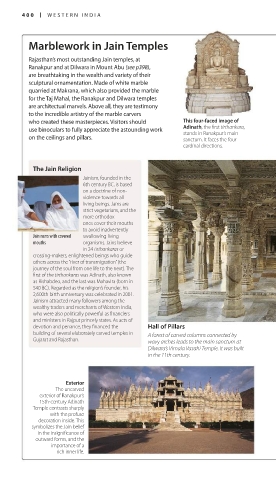
who created these masterpieces. Visitors should This four-faced image of
use binoculars to fully appreciate the astounding work Adinath, the first tirthankara,
stands in Ranakpur’s main
on the ceilings and pillars. sanctum. It faces the four
cardinal directions.
The Jain Religion
Jainism, founded in the
6th century BC, is based
on a doctrine of non-
violence towards all
living beings. Jains are
strict vegetarians, and the
more orthodox
ones cover their mouths
to avoid inadvertently
Jain nuns with covered swallowing living
mouths organisms. Jains believe
in 24 tirthankaras or
crossing-makers, enlightened beings who guide
others across the “river of transmigration” (the
journey of the soul from one life to the next). The
first of the tirthankaras was Adinath, also known
as Rishabdeo, and the last was Mahavira (born in
540 BC). Regarded as the religion’s founder, his
2,600th birth anniversary was celebrated in 2001.
Jainism attracted many followers among the
wealthy traders and merchants of Western India,
who were also politically powerful as financiers
and ministers in Rajput princely states. As acts of
devotion and penance, they financed the Hall of Pillars
building of several elaborately carved temples in A forest of carved columns connected by
Gujarat and Rajasthan. wavy arches leads to the main sanctum at
Dilwara’s Vimala Vasahi Temple. It was built
in the 11th century.
Exterior
The uncarved
exterior of Ranakpur’s
15th-century Adinath
Temple contrasts sharply
with the profuse
decoration inside. This
symbolizes the Jain belief
in the insignificance of
outward forms, and the
importance of a
rich inner life.
400-IND-AT509-1251-RAJ7SS.indd 400 29/04/14 7:07 pm
Eyewitness Travel LAYERS PRINTED:
Feature template “UK” LAYER
(SourceReport v1.3)
Date 18th October 2012
Size 125mm x 217mm

