


Page 406 - (DK Eyewitness) Travel Guide - India
P. 406
404 WESTERN INDIA
Udaipur: City Palace
Stretching along the eastern shore of Lake Pichola,
Udaipur’s City Palace is a fascinating combination of
Rajput military architecture and Mughal-style decorative
techniques. Its stern, fortress-like façade, topped by a
profusion of graceful balconies, cupolas and turrets,
has been aptly described by one writer as a massive plain
cake topped with fabulous icing. The largest palace in
Rajasthan, covering an area of 2 ha (5 acres), the City
Palace is actually a complex of several palaces, built or
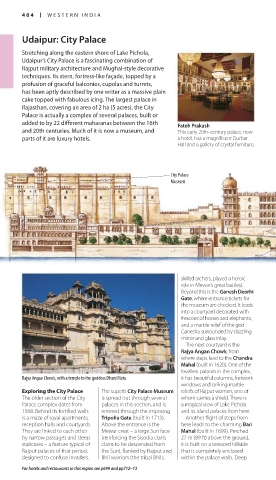
added to by 22 different maharanas between the 16th Fateh Prakash
and 20th centuries. Much of it is now a museum, and This early 20th-century palace, now
parts of it are luxury hotels. a hotel, has a magnif icent Durbar
Hall and a gallery of crystal furniture.
City Palace
Museum
skilled archers, played a heroic
role in Mewar’s great battles).
Beyond this is the Ganesh Deorhi
Gate, where entrance tickets for
the museum are checked. It leads
into a courtyard decorated with
frescoes of horses and elephants,
and a marble relief of the god
Ganesha surrounded by dazzling
mirror and glass inlay.
The next courtyard is the
Rajya Angan Chowk, from
where steps lead to the Chandra
Mahal (built in 1620). One of the
loveliest palaces in the complex,
Rajya Angan Chowk, with a temple to the goddess Dhuni Mata it has beautiful columns, fretwork
windows and striking marble
Exploring the City Palace The superb City Palace Museum reliefs of Rajput women, one of
The older section of the City is spread out through several whom carries a shield. There is
Palace complex dates from palaces in this section, and is a magical view of Lake Pichola
1568. Behind its fortified walls entered through the imposing and its island palaces from here.
is a maze of royal apartments, Tripolia Gate (built in 1713). Another flight of steps from
reception halls and courtyards. Above the entrance is the here leads to the charming Bari
They are linked to each other Mewar crest – a large Sun face Mahal (built in 1699). Perched
by narrow passages and steep (reinforcing the Sisodia clan’s 27 m (89 ft) above the ground,
staircases – a feature typical of claim to be descended from it is built on a terraced hillside
Rajput palaces of that period, the Sun), flanked by Rajput and that is completely enclosed
designed to confuse invaders. Bhil warriors (the tribal Bhils, within the palace walls. Deep
For hotels and restaurants in this region see p699 and pp712–13
404-405_EW_India.indd 404 26/04/17 11:46 am
Eyewitness Travel LAYERS PRINTED:
Catalogue template “UK” LAYER
(Source v2.6)
Date 12th July 2013
Size 125mm x 217mm

