


Page 459 - (DK Eyewitness) Travel Guide - India
P. 459
MUMBAI 457
Chowk (“Martyrs’ Square”). This q Crawford Market
area marks the western ramparts Dr Dadabhai Naoroji Rd & Lokmanya
of the now-vanished old Fort, Tilak Rd. Shops: Open daily (partially
which was built by the East India closed on Sun).
Company in 1716, and covered
the southern part of the city. The Built on the orders of Sir Arthur
Fort was demolished in the 1860s Crawford, Bombay’s first
by the governor, Sir Bartle Frere, Municipal Commissioner (1865–
to allow the city to expand, and 71), Crawford Market, now known
to accommodate the grandiose as Mahatma Jyotiba/Jyotirao
new civic and commercial Phule Market, lies to the north
buildings he had planned. All of Chhatrapati Shivaji Terminus.
these buildings were designed Designed by William Emerson
with pedes trian arcades, which and completed in 1869, the
today are crowded with hawkers Crawford was the first building
selling a wide range of goods, in India to be lit up by electricity.
The Bombay Stock Exchange, India’s from old books to clothes and This architectural extravaganza of
financial epicentre electronic gadgets. Moorish arches and half-timbered
North of Flora Fountain, gables, topped by a clocktower,
8 Bombay Stock leading towards Chhatrapati consists of a central hall with two
Exchange Shivaji Terminus, is Dadabhai wings. Tiers of wooden stalls
Naoroji (DN) Road, lined with display nearly 3,000 tonnes of
Dalal Street, Fort Area. Closed to public. magnificent Victorian and later fresh produce daily, from fruit and
Asia’s first stock exchange and colonial structures such as the flowers to fish and exotic birds.
India’s financial epicentre, the now-closed Capitol Cinema The floor is paved with stone
Bombay Stock Exchange towers with its classical detailing, the from Scotland, which remains
above Dalal Street. This is JN Petit Institute and cool through the day. The
Mumbai’s Wall Street and derives Library (1898) with its lamp brackets are
its name from the many stock- Venetian Neo-Gothic shaped like winged
brokers (dalals) in the area. The façade, and the Art dragons. Above the
presence of close to 50 banks on Deco Watcha Agiary entrance doors, the
a short stretch underlines the (Parsi Fire Temple) with marble bas-reliefs
frenetic pace of its commercial its Assyrian-style depict scenes from
activity. Just before lunchtime, carvings, built in 1881. market life. They
the area swarms with Other interesting were carved by
dabbawallahs (see p461) who structures include Lockwood Kipling
bring home-made lunchboxes the Indo-Saracenic (see p114), father of
to the thousands of office Times of India Flora Fountain, a favourite the writer Rudyard
workers in the area. Building and the Mumbai landmark Kipling, as was
fanciful Municipal the fountain in the
Corporation Building, with its courtyard decorated with Hindu
9 Flora Fountain Islamic minarets, Gothic towers river goddesses and animals.
and onion domes. West of the market is Zaveri
Junction of Veer Nariman Rd, MG Rd &
Dr Dadabhai Naoroji Rd, Fort Area. Bazaar, where diamond, gold
and silver merchants have their
Standing at the intersection 0 Chhatrapati opulent stores. Northwest of the
of three major streets is Flora Shivaji Terminus market, on Mutton Street, is Chor
Fountain, the quintessential Bazaar (“Thieves’ Market”), with
icon of Mumbai. Sculpted out See pp458–9. its antiques and bric-a-brac shops.
of Portland stone by James
Forsythe and shipped out
from England, the fountain
is surmounted by the Roman
goddess Flora, who stands above
exuberantly carved sea shells,
dolphins and mythical beasts.
Erected in 1869, in what was
then a spacious open plaza, Flora
Fountain is now swamped in a
sea of traffic, and overshadowed
by a Martyrs’ Memorial put
up by the Maharashtra state
government in 1960. The area
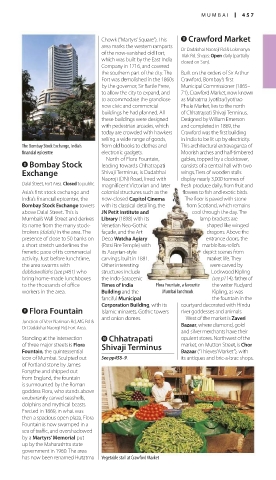
has now been renamed Hutatma Vegetable stall at Crawford Market
456-457_EW_India.indd 457 26/04/17 11:47 am

