


Page 463 - (DK Eyewitness) Travel Guide - India
P. 463
MUMBAI 461
e Ballard Estate
Bounded by Shahid Bhagat Singh
Marg, Walchand Hirachand Marg &
Shoorji Vallabhdas Marg.
This entire area was once
part of the sea until it was
reclaimed by the Bombay
Port Trust and converted into
a business district. Planned
between 1908 and 1914 by
George Wittet, architect of
the Gateway of India, the area
was developed according to
the strict guidelines set by
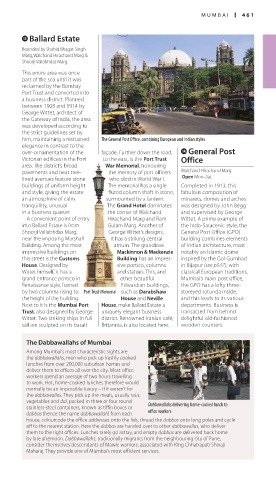
him, maintaining a restrained The General Post Office, combining European and Indian styles
elegance in contrast to the
over-ornamentation of the façade. Further down the road, r General Post
Victorian edifices in the Fort to the east, is the Port Trust Office
area. The district’s broad War Memorial, honouring
pavements and neat tree- the memory of port officers Walchand Hirachand Marg.
lined avenues feature stone who died in World War I. Open Mon–Sat.
buildings of uniform height The memorial has a single Completed in 1913, this
and style, giving the estate fluted column shaft in stone, fabulous composition of
an atmosphere of calm surmounted by a lantern. minarets, domes and arches
tranquillity, unusual The Grand Hotel dominates was designed by John Begg
in a business quarter. the corner of Walchand and supervised by George
A convenient point of entry Hirachand Marg and Ram Wittet. A prime example of
into Ballard Estate is from Gulam Marg. Another of the Indo-Saracenic style, the
Shoorji Vallabhdas Marg, George Wittet’s designs, General Post Office (GPO)
near the imposing Marshall it has a striking central building combines elements
Building. Among the most atrium. The grandiose of Indian architecture, most
impressive buildings on Mackinnon & Mackenzie notably an Islamic dome
this street is the Customs Building has an impres- inspired by the Gol Gumbad
House. Designed by sive portico, columns in Bijapur (see p547), with
Wittet himself, it has a and statues. This, and classical European traditions.
grand entrance portico in other beautiful Mumbai’s main post office,
Renaissance style, framed Edwardian buildings, the GPO has a lofty three-
by two columns rising to Port Trust Memorial such as Darabshaw storeyed rotunda inside,
the height of the building. House and Neville and this leads to its various
Next to it is the Mumbai Port House, make Ballard Estate a departments. Business is
Trust, also designed by George uniquely elegant business transacted from behind
Wittet. Two striking ships in full district. Renowned Iranian café, delightful old-fashioned
sail are sculpted on its basalt Britannia, is also located here. wooden counters.
The Dabbawallahs of Mumbai
Among Mumbai’s most characteristic sights are
the dabbawallahs, men who pick up freshly cooked
lunches from over 200,000 suburban homes and
deliver them to offices all over the city. Most office
workers spend an average of two hours travelling
to work. Hot, home-cooked lunches therefore would
normally be an impossible luxury – if it weren’t for
the dabbawallas. They pick up the meals, usually rotis,
vegetables and dal, packed in three or four round
stainless-steel containers, known as tiffin boxes or Dabbawallahs delivering home-cooked lunch to
dabbas (hence the name dabbawallah) from each office workers
house, colourcode the office addresses onto the lids, thread the dabbas onto long poles and cycle
off to the nearest station. Here the dabbas are handed over to other dabbawallas, who deliver
them to the right offices. Lunches rarely go astray, and empty dabbas are delivered back home
by late afternoon. Dabbawallahs, traditionally migrants from the neighbouring city of Pune,
consider themselves descendants of Mawle warriors, associated with King Chhatrapati Shivaji
Maharaj. They provide one of Mumbai’s most efficient services.
460-461_EW_India.indd 461 26/04/17 11:47 am

