


Page 467 - (DK Eyewitness) Travel Guide - India
P. 467
MUMBAI 465
g Elephanta Island VISITORS’ CHECKLIST
Located on an island off Mumbai’s eastern shore, the Practical Information
6th-century AD Elephanta cave temples, chiselled into 9 km (6 miles) NE of Mumbai.
n for ferries, (022) 2202 6364.
a rocky cliff and dedicated to Shiva, contain some great Open daily. & 8 _ Elephanta
masterpieces of Indian sculpture. Originally called Music & Dance Festival (Feb).
Gharapuri, or “Island of Caves”, the island was renamed Transport
Elephanta by the Portuguese after a huge stone elephant 4 from Gateway of India (every
that once stood here. This is now in the garden of the Bhau 30 minutes 9am onwards: last
Daji Lad Museum in Mumbai’s Byculla area. A UNESCO entry 3:30pm)
World Heritage Site, the Elephanta cave temples can be
visited via an hour-long ferry ride from Mumbai.
1
0 metres 20
7
0 yards 20
8
5
9
6
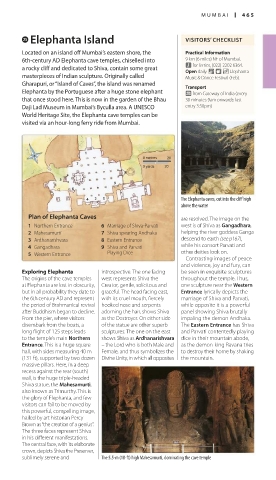
4 2 3 The Elephanta caves, cut into the cliff high
above the water
Plan of Elephanta Caves are resolved. The image on the
1 Northern Entrance 6 Marriage of Shiva-Parvati west is of Shiva as Gangadhara,
2 Mahesamurti 7 Shiva spearing Andhaka help ing the river goddess Ganga
3 Ardhanarishvara 8 Eastern Entrance descend to earth (see p167),
4 Gangadhara 9 Shiva and Parvati while his consort Parvati and
5 Western Entrance Playing Dice other deities look on.
Contrasting images of peace
and violence, joy and fury, can
Exploring Elephanta introspective. The one facing be seen in exquisite sculptures
The origins of the cave temples west represents Shiva the throughout the temple. Thus,
at Elephanta are lost in obscurity, Creator, gentle, solicitous and one sculpture near the Western
but in all probability they date to graceful. The head facing east, Entrance lyrically depicts the
the 6th century AD and represent with its cruel mouth, fiercely marriage of Shiva and Parvati,
the period of Brahmanical revival hooked nose and serpents while opposite it is a powerful
after Buddhism began to decline. adorning the hair, shows Shiva panel showing Shiva brutally
From the pier, where visitors as the Destroyer. On either side impaling the demon Andhaka.
disembark from the boats, a of the statue are other superb The Eastern Entrance has Shiva
long flight of 125 steps leads sculptures. The one on the east and Parvati contentedly playing
to the temple’s main Northern shows Shiva as Ardhanarishvara dice in their mountain abode,
Entrance. This is a huge square – the Lord who is both Male and as the demon-king Ravana tries
hall, with sides measuring 40 m Female, and thus symbolizes the to destroy their home by shaking
(131 ft), supported by two dozen Divine Unity, in which all opposites the mountain.
massive pillars. Here, in a deep
recess against the rear (south)
wall, is the huge triple-headed
Shiva statue, the Mahesamurti,
also known as Trimurthy. This is
the glory of Elephanta, and few
visitors can fail to be moved by
this powerful, compelling image,
hailed by art historian Percy
Brown as “the creation of a genius”.
The three faces represent Shiva
in his different manifestations.
The central face, with its elaborate
crown, depicts Shiva the Preserver,
sublimely serene and The 5.5-m (18-ft) high Mahesamurti, dominating the cave temple
464-465_EW_India.indd 465 26/04/17 11:54 am

