


Page 47 - (DK Eyewitness) Travel Guide - India
P. 47
INTRODUCING INDIA 45
THE HISTORY
OF INDIA
The name India comes from “Indoi”, a Greek word for the people who
lived beyond the Indus river. The roots of Indian civilization lie in the
country’s precise and awe-inspiring natural boundaries, formed by
the Himalayas in the north, and seas to the east, south and west.
These have fostered a remarkable physical and cultural unity, despite
the size and diversity of the area they enclose.
Indus Valley Civilization Sanskrit text of that period, they had
Prehistoric sites in India date back to a mixed pastoral and agrarian economy.
at least 250,000 BC, with agricultural Three later Vedas, written between
settlements appearing around 7000 BC. 1000–600 BC, and associated Sanskrit
By 2500 BC, a sophisticated urban texts, record the extension of their
civilization emerged, stretching across settlements across the Gangetic Valley.
the Indus Valley and northwest India, This was also the time of the Mahabharata
all the way down to Gujarat. Its main epic (see p30), which describes a great
cities were marked by solid brick war between two clans.
structures, roads in a grid pattern, and While the Rig Vedic religion worshipped
elaborate drainage systems. Stone seals nature gods, the deities of the later Vedic
with an as-yet-undeciphered script, and period were more complex. Later Vedic
standardized weights and measures literature included a remarkable set of
were among the artifacts found in Sanskrit treatises called the Upanishads,
this culture (also known as Harappan which advocated a philosophical quest
Civilization), which had a thriving trade for truth, through enquiry. By this period,
with Mesopotamia. Remains of two of a social structure based on the caste
these cities can be seen at Lothal and system had developed. It was earlier
Dholavira in Gujarat. By 1800 BC, these occupational, but was now becoming
cities declined, perhaps because of hereditary and increasingly rigid. At
tectonic or ecological changes. the apex were the Brahmins or priests,
followed by the kshatriyas (rulers and
The Vedic Age warriors). Below them were vaishyas
Around 1500 BC, a people commonly (farmers and traders), and shudras (servants
known as the Aryans, who were probably and labourers). Sacrifices and rituals to
migrants from Central Asia, settled in the appease the gods were prescribed by
Indus region. Described in the Rig Veda, a the Vedas, and became a part of daily life.
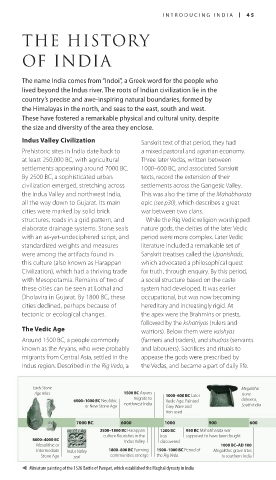
Early Stone Megalithic
Age relics 1500 BC Aryans 1000–600 BC Later stone
migrate to
6000–1000 BC Neolithic Vedic Age. Painted dolmens,
or New Stone Age northwest India Grey Ware and South India
iron used
7000 BC 6000 1000 900 600
2500–1800 BC Harappan 1200 BC 950 BC Mahabharata war
culture flourishes in the Iron supposed to have been fought
8000–4000 BC Indus Valley discovered
Mesolithic or 1000 BC–AD 100
Intermediate Indus Valley 1800–800 BC Farming 1500–1000 BC Period of Megalithic grave sites
Stone Age seal communities emerge the Rig Veda in southern India
Miniature painting of the 1526 Battle of Panipat, which established the Mughal dynasty in India
044-045_EW_India.indd 45 26/04/17 11:42 am

