


Page 48 - (DK Eyewitness) Travel Guide - India
P. 48
46 INTRODUCING INDIA
The Age of Mahavira and Buddha
The 6th century BC saw the rise of several
urban centres in the north, accompanied
by widespread trade. Urbanization led to
changes in social stratification, and encour
aged the emergence of new religious sects,
which challenged Brahmin dominance. Chief
among these were Buddhism and Jainism,
founded respectively by Gautama
Siddhartha (566–486 BC), who became the
Buddha, and Vardhamana Mahavira (540–
467 BC). These religions gained popularity, as
they subscribed to neither caste nor ritual
sacrifice, and were open to everyone,
including women. The Buddha’s simple yet
profound teachings (see p225) had
particularly wide appeal. Mahavira believed
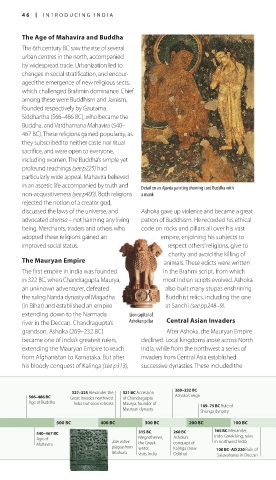
in an ascetic life accompanied by truth and Detail on an Ajanta painting showing Lord Buddha with
nonacquisitiveness (see p400). Both religions a monk
rejected the notion of a creator god,
discussed the laws of the universe, and Ashoka gave up violence and became a great
advocated ahimsa – not harming any living patron of Buddhism. He recorded his ethical
being. Merchants, traders and others who code on rocks and pillars all over his vast
adopted these religions gained an empire, enjoining his subjects to
improved social status. respect others’ religions, give to
charity and avoid the killing of
The Mauryan Empire animals. These edicts were written
The first empire in India was founded in the Brahmi script, from which
in 322 BC, when Chandragupta Maurya, most Indian scripts evolved. Ashoka
an unknown adventurer, defeated also built many stupas enshrining
the ruling Nanda dynasty of Magadha Buddhist relics, including the one
(in Bihar) and established an empire at Sanchi (see pp248–9).
extending down to the Narmada Lion capital of
river in the Deccan. Chandragupta’s Ashokan pillar Central Asian Invaders
grandson, Ashoka (269–232 BC) After Ashoka, the Mauryan Empire
became one of India’s greatest rulers, declined. Local kingdoms arose across North
extending the Mauryan Empire to reach India, while from the northwest a series of
from Afghanistan to Karnataka. But after invaders from Central Asia established
his bloody conquest of Kalinga (see p313), successive dynasties. These included the
269–232 BC
327–325 Alexander the 321 BC Accession
566–486 BC Great invades northwest of Chandragupta Ashoka’s reign
Age of Buddha India but soon retreats Maurya, founder of
Mauryan dynasty 189–75 BC Rule of
Shunga dynasty
500 BC 400 BC 300 BC 200 BC 100 BC
540–467 BC 315 BC 260 BC 165 BC Menander,
Age of Megasthenes, Ashoka’s IndoGreek king, rules
Mahavira Jain votive the Greek conquest of in northwest India
plaque from writer, Kalinga (now 100 BC–AD 220 Rule of
Mathura visits India Odisha) Satavahanas in Deccan
046-047_EW_India.indd 46 26/04/17 11:42 am
Eyewitness Travel LAYERS PRINTED:
History Portrait template “UK” LAYER
(Source v1.2)
Date 20th August 2012
Size 125mm x 217mm

