


Page 473 - (DK Eyewitness) Travel Guide - India
P. 473
M AHAR ASHTR A 471
Ganesha, the Remover of Obstacles
Lord Ganesha, the elephant-headed son of Shiva and Parvati, is the most auspicious
and popular deity in India, and especially beloved in Maharashtra. Images of the
endearing, potbellied god are found in every household, on temple doorways and
shop entrances, on letterheads and wedding invitations. No task or enterprise is
ever begun without invoking him, as he is the Lord of New Beginnings. Worshipped
in many guises, he is Vighneshwara, the Remover of Obstacles, and Siddhidata, the
God of Prosperity and Success. Ganesha is above all a friend, lovable and benign,
and his festival, Ganesha Chaturthi, crosses all social boundaries, uniting the people
of Maharashtra in a frenzied ten-day celebration.
Lord Ganesha
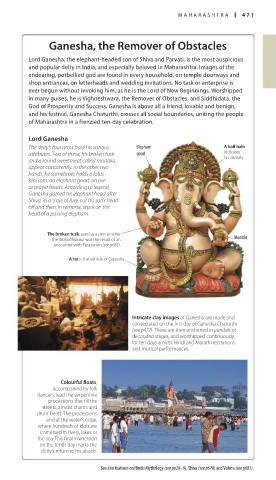
The deity’s four arms hold his various Elephant A half halo
attributes. Two of these, his broken tusk goad indicates
his divinity.
and a round sweetmeat called modaka,
appear consistently. In the other two
hands, he sometimes holds a lotus
blossom, an elephant goad, an axe
or prayer beads. According to legend,
Ganesha gained his elephant head after
Shiva, in a state of fury, cut his son’s head
off and then, in remorse, stuck on the
head of a passing elephant.
The broken tusk, used as a pen to write
the Mahabharata, was the result of an Modaka
encounter with Parasuram (see p683).
A rat is the vehicle of Ganesha
Intricate clay images of Ganesha are made and
consecrated on the first day of Ganesha Chaturthi
(see p477). These are then enshrined in pandals or
decorated stages, and worshipped continuously
for ten days amidst Hindi and Marathi recitations
and musical performances.
Colourful floats,
accompanied by folk
dancers, lead the serpentine
processions that fill the
streets, amidst chants and
drum beats. The processions
end at the water’s edge,
where hundreds of idols are
immersed in rivers, lakes or
the sea. This final immersion
on the tenth day marks the
deity’s return to his abode.
See also features on Hindu Mythology (see pp28–9), Shiva (see p570) and Vishnu (see p683).
470-471_EW_India.indd 471 26/04/17 11:47 am

