


Page 477 - (DK Eyewitness) Travel Guide - India
P. 477
M AHAR ASHTR A 475
Shivaji and the Marathas
Maharashtra’s greatest hero, Shivaji, was born in 1627 to Shahji Bhonsle, a chieftain from
Pune who served the sultans of Bijapur (see pp546–9). Daring, ambitious and restless
since his boyhood, by the age of 19 he had become the head of a band of intrepid
fighters. Soon, Shivaji’s brilliant guerrilla tactics against Emperor Aurangzeb and the
powerful Mughal army, and his swift conquests of mountain and sea forts, enabled him
to establish a separate Maratha kingdom. In 1674, he was crowned Chhatrapati, the
traditional title of a Hindu monarch, at his capital, Raigad. When he died in 1680, at the
age of 53, he left behind a powerful Maratha state, which continued to play an important
role in Indian history for the next 100 years.
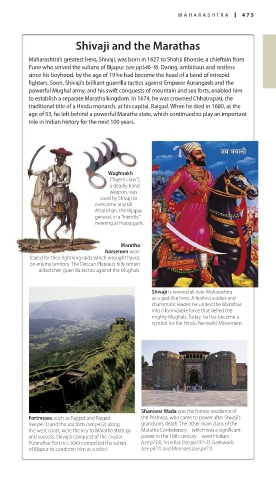
Waghnakh
(“tiger’s claw”),
a deadly hand
weapon, was
used by Shivaji to
overcome and kill
Afzal Khan, the Bijapur
general, in a “friendly”
meeting at Pratapgarh.
Maratha
horsemen were
feared for their lightning raids which wrought havoc
on enemy territory. The Deccan Plateau’s hilly terrain
aided their guerrilla tactics against the Mughals.
Shivaji is revered all over Maharashtra
as a god-like hero. A fearless soldier and
charismatic leader, he united the Marathas
into a formidable force that defied the
mighty Mughals. Today, he has become a
symbol for the Hindu Revivalist Movement.
Shaniwar Wada was the former residence of
Fortresses, such as Rajgad and Raigad the Peshwas, who came to power after Shivaji’s
(see p473) and the sea forts (see p472) along grandson’s death. The other main clans of the
the west coast, were the key to Maratha strategy Maratha Confederacy – which was a significant
and success. Shivaji’s conquest of the crucial power in the 18th century – were Holkars
Purandhar Fort in c.1649 compelled the sultan (see p250), Scindias (see pp232–3), Gaekwads
of Bijapur to condemn him as a rebel. (see p422) and Bhonsles (see p472).
474-475_EW_India.indd 475 26/04/17 11:47 am

