


Page 481 - (DK Eyewitness) Travel Guide - India
P. 481
M AHAR ASHTR A 479
w Daulatabad into Kataka, the inner fort.
Gateways lead through fortified
Aurangabad district. 13 km (8 miles)
NW of Aurangabad. @ Bus tours walls into the base of the citadel,
are offered by Maharashtra Tourism, known as Balakot, separated
Aurangabad, (0240) 234 3169. by a moat that was once
Taxis & jeeps also available from infested by crocodiles.
Aurangabad. Open daily. & Near the innermost gate lies
the blue-and-white tiled Chini
Perched on a granite outcrop Mahal, where the last sultan of
of the Deccan Plateau, this Golconda was imprisoned by
formidable fort has witnessed Aurangzeb in 1687. On a nearby
some of the greatest carnage in bastion is the enormous bronze
the region. Originally known as cannon, the Qila Shikhan or
Deogiri, it was captured in 1296 “Fort Breaker”. This 6-m (20-ft)
by Alauddin Khilji, the Deccan’s long cannon has a splendid ram’s
An ornately carved pillared hall in Cave 3, first Muslim invader from Delhi. head, and Persian inscriptions
Aurangabad Caves He was followed by Muhammad along its length refer to it as
bin Tughluq, who annexed the the “Creator of Storms”. A series
cotton and silver threads, fort in 1328 and renamed the of dark tunnels lead to the
producing himroo, which literally town Daulatabad (“City of citadel’s heart and end near
means similar. A variety of such Fortune”). In a fit of misguided a pillared pavilion, Baradari, a
shawls and saris are available reasoning, he decided to shift late Mughal building. The fort’s
in showrooms across town. his capital here, and compelled ramparts offer sweeping views.
The factory also produces rich Delhi’s entire population
Paithani saris, intricately woven to march across 1,127 km Environs
with gold thread. (700 miles). Thousands died The walled village of Khuldabad
of starvation or disease along (“Heavenly Abode”) is 10 km
Environs the way, and when (6 miles) north of Daulatabad.
About 3 km (2 miles) the move failed, the The Alamgir Dargah, dedicated
north are the sultan and his court to the Muslim saint, Sayeed
Aurangabad Caves. marched back to Zain-ud-din, (d.1370), is its most
Mainly excavated Delhi. Daulatabad famous monument. Also known
during the Vakataka was successively as Rauza, this reli gious complex,
and Kalachuri conquered by the established by Sufi saints in the
periods (6th and 7th Deccani Bahmani 14th century, was considered
centuries), these caves sultans, the Nizam so sacred that several Deccani
can be divided into Shahis, the Mughals, sultans chose to be buried here.
two groups. Of the the Marathas and Emperor Aurangzeb, who died
five caves in the Himroo fabric, finally, the Nizam in the Deccan in 1707, is buried in
western group, the Aurangabad of Hyderabad – a simple tomb in the courtyard.
oldest is Cave 4, dating each conquest The beautiful tomb of Malik
to the 1st century AD. It is a fine proving more bloody and Ambar (see p477), is a short
chaitya griha with a monolithic savage than the last. distance to the north.
stupa. Carved on the rock face The pyramid-shaped hill,
outside is a superb image of on which the imposing fort
the Buddha, seated on a lion is built, stands apart from the
throne. Cave 3 (5th century) surrounding ranges, and towers
has an inge niously designed to a height of 183 m (600 ft).
pillared hall that is acoustically This made Mughal emperor
sensitive and amplifies sound. Shah Jahan’s chronicler note
Inside the inner sanctum, a that “neither ant nor snake could
Seated Buddha is flanked by scale it”. Four solid concentric
devotees with floral offerings. walls protect the fort. The first
The eastern group, nearby, of its three zones is Ambarkot,
comprises four caves. Cave 6 has the outer fort. Within stands the
delicately sculpted Bodhisattvas, 60-m (197-ft) high victory tower,
surrounded by flying figures. Chand Minar, built in 1435 by
The most splendid of the caves Alauddin Bahmani to celebrate
is Cave 7, a sumptuous shrine his conquest of the fort. In the
with large sculptures of Tara and nearby Jama Masjid, 106 pillars
Avalo kitesvara (see p145). Its inner from Jain and Hindu temples
sanctum has a superb frieze of a separate the main hall into 25
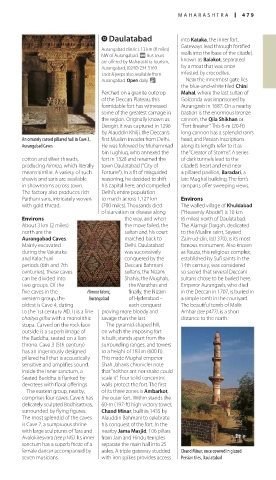
female dancer accompanied by aisles. A triple gateway studded Chand Minar, once covered in glazed
seven musicians. with iron spikes provides access Persian tiles, Daulatabad
478-479_EW_India.indd 479 26/04/17 11:47 am

