


Page 607 - (DK Eyewitness) Travel Guide - India
P. 607
T A MIL NADU 605
Environs first took place in 1371,
At Kallanai, 24 km (15 miles) after the original 10th-
northeast of Tiruchirapalli, is century temple was
a 300-m (984-ft) long earthen destroyed by the Delhi
dam across the Kaveri river, the Sultan, Alauddin Khilji
Grand Anicut. This formed part (see p52). Its present form,
of the huge hydraulic system however, includes
created by the Cholas (see pp50– extensions added in
51) to divert water from the river the 17th century by the
into a vast network of irrigation Nayaka rulers, whose
canals. The original no longer second capital was
exists, and the dam in operation in neighbouring
today was rebuilt by British Tiruchirapalli. The last
engineers in the 19th century. addition was in 1987,
Other places of interest are when the unfinished
the 7th-century Shiva temple at southern gateway was
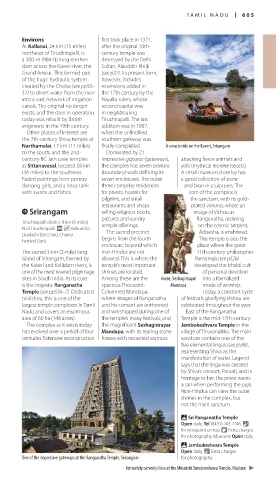
Narthamalai, 17 km (11 miles) finally completed. A coracle ride on the Kaveri, Srirangam
to the south, and the 2nd- Dominated by 21
century BC Jain cave temples impressive gopuras (gateways), attacking fierce animals and
at Sittanavasal, located 58 km the complex has seven prakara yalis (mythical leonine beasts).
(36 miles) to the southeast. (boundary) walls defining its A small museum close by has
Faded paintings here portray seven enclosures. The outer a good collection of stone
dancing girls, and a lotus tank three comprise residences and bronze sculptures. The
with swans and fishes. for priests, hostels for core of the complex is
pilgrims, and small the sanctum, with its gold-
restaurants and shops plated vimana, where an
t Srirangam selling religious books, image of Vishnu as
pictures and sundry Ranganatha, reclining
Tiruchirapalli district. 9 km (6 miles) temple offerings. on the cosmic serpent,
N of Tiruchirapalli. @ _ Vaikuntha
Eka dashi (Dec/Jan), Chariot The sacred precinct Adisesha, is enshrined.
Festival (Jan). begins from the fourth This temple is also the
enclosure, beyond which place where the great
The sacred 3-km (2-mile) long non-Hindus are not 11th-century philosopher
island of Srirangam, formed by allowed. This is where the Ramanuja (see p526)
the Kaveri and Kollidam rivers, is temple’s most important developed the bhakti cult
one of the most revered pilgrimage shrines are located. of personal devotion
sites in South India. At its core Among these are the Horse, Sesha girirayar into a formalized
is the majestic Ranganatha spacious Thousand- Mandapa mode of worship.
Temple (see pp556–7). Dedicated Columned Mandapa, Today, a constant cycle
to Vishnu, this is one of the where images of Ranganatha of festivals glorifying Vishnu are
largest temple complexes in Tamil and his consort are enthroned cele brated throughout the year.
Nadu and covers an enormous and worshipped during one of East of the Ranganatha
area of 60 ha (148 acres). the temple’s many festivals, and Temple is the mid-17th-century
The complex as it exists today the magnificent Seshagirirayar Jambukeshvara Temple in the
has evolved over a period of four Mandapa, with its rearing stone village of Tiruvanaikka. The main
centuries. Extensive reconstruction horses with mounted warriors sanctum contains one of the
five elemental lingas (see p588),
representing Shiva as the
manifestation of water. Legend
says that the linga was created
by Shiva’s consort, Parvati, and in
homage to her, the priest wears
a sari when performing the puja.
Non-Hindus can view the outer
shrines in the complex, but
not the main sanctum.
Sri Ranganatha Temple
Open daily. Tel (0431) 243 2246. &
for viewpoint on top. 8 Extra charges
for photography. Museum: Open daily.
Jambukeshvara Temple
Open daily. & Extra charges
One of the impressive gateways at the Ranganatha Temple, Srirangam for photography.
Intricately carved pillars at the Minakshi Sundareshvara Temple, Madurai
604-605_EW_India.indd 605 26/04/17 11:49 am

