


Page 606 - (DK Eyewitness) Travel Guide - India
P. 606
604 SOUTH INDIA
to the 18th and 19th centuries,
when the British constructed
the cantonment and numerous
civic buildings and churches.
Many of these buildings are
located around the large
Teppakulam Tank at the base
of the fort – a busy area
surrounded by fruit, vegetable
and flower markets.
Among the town’s earliest
churches are Christ Church
(1766), founded by Reverend
Frederick Christian Schwartz
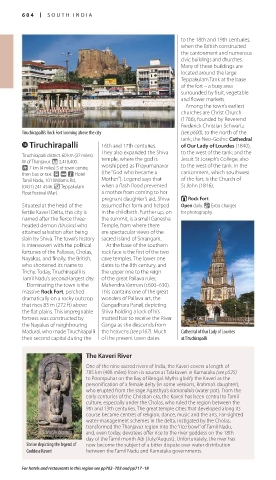
Tiruchirapalli’s Rock Fort looming above the city (see p600), to the north of the
tank; the Neo-Gothic Cathedral
r Tiruchirapalli 16th and 17th centuries. of Our Lady of Lourdes (1840),
They also expanded the Shiva to the west of the tank; and the
Tiruchirapalli district. 60 km (37 miles)
W of Thanjavur. * 2,418,400. temple, where the god is Jesuit St Joseph’s College, also
~ 7 km (4 miles) S of town centre, worshipped as Thayumanavar to the west of the tank. In the
then bus or taxi. £ @ n Hotel (the “God who became a cantonment, which southwest
Tamil Nadu, 101 Williams Rd, Mother”). Legend says that of the fort, is the Church of
(0431) 241 4346. _ Teppakulam when a flash flood prevented St John (1816).
Float Festival (Mar). a mother from coming to her
pregnant daughter’s aid, Shiva T Rock Fort
Situated at the head of the assumed her form and helped Open daily. & Extra charges
fertile Kaveri Delta, this city is in the childbirth. Further up, on for photography.
named after the fierce three- the summit, is a small Ganesha
headed demon (tirusira) who Temple, from where there
attained salvation after being are spectacular views of the
slain by Shiva. The town’s history sacred island of Srirangam.
is interwoven with the political At the base of the southern
fortunes of the Pallavas, Cholas, rock face is the first of the two
Nayakas, and finally, the British, cave temples. The lower one
who shortened its name to dates to the 8th century, and
Trichy. Today, Tiruchirapalli is the upper one to the reign
Tamil Nadu’s second-largest city. of the great Pallava ruler,
Dominating the town is the Mahendra Varman (r.600–630).
massive Rock Fort, perched This contains one of the great
dramatically on a rocky outcrop wonders of Pallava art, the
that rises 83 m (272 ft) above Gangadhara Panel, depicting
the flat plains. This impregnable Shiva holding a lock of his
fortress was constructed by matted hair to receive the River
the Nayakas of neighbouring Ganga as she descends from
Madurai, who made Tiruchirapalli the heavens (see p167). Much Cathedral of Our Lady of Lourdes
their second capital during the of the present town dates at Tiruchirapalli
The Kaveri River
One of the nine sacred rivers of India, the Kaveri covers a length of
785 km (488 miles) from its source at Talakaveri in Karnataka (see p525)
to Poompuhar on the Bay of Bengal. Myths glorify the Kaveri as the
personification of a female deity (in some versions, Brahma’s daughter),
who erupted from the sage Agasthya’s kamandala (water pot). From the
early centuries of the Christian era, the Kaveri has been central to Tamil
culture, especially under the Cholas, who ruled the region between the
9th and 13th centuries. The great temple cities that developed along its
course became centres of religion, dance, music and the arts. Far-sighted
water-management schemes in the delta, instigated by the Cholas,
transformed the Thanjavur region into the “rice bowl” of Tamil Nadu,
and, even today, devotees offer rice to the river goddess on the 18th
day of the Tamil month Adi (July/August). Unfortunately, the river has
Shrine depicting the legend of now become the subject of a bitter dispute over water distribution
Goddess Kaveri between the Tamil Nadu and Karnataka governments.
For hotels and restaurants in this region see pp702–703 and pp717–18
604-605_EW_India.indd 604 26/04/17 11:49 am
Eyewitness Travel LAYERS PRINTED:
Catalogue template “UK” LAYER
(Source v2.6)
Date 12th July 2013
Size 125mm x 217mm

