


Page 602 - (DK Eyewitness) Travel Guide - India
P. 602
600 SOUTH INDIA
e Thanjavur
The city of Thanjavur, or Tanjore, lies in the fertile Kaveri Delta,
a region often referred to as the “rice bowl of Tamil Nadu”. For
nearly a thousand years, this great town dominated the political
history of the region as the capital of three powerful dynasties –
the Cholas (9th–13th centuries), the Nayakas (1535–1676)
and the Marathas (1676–1855). The magnificent Brihadishvara
Temple (see pp602–603) is the most important Chola monument,
while the Royal Palace dates to the Nayaka and Maratha periods.
Today, Thanjavur’s culture extends beyond temples and palaces,
to encompass classical music and dance. It is also a flourishing
centre for bronze sculpture and painting.
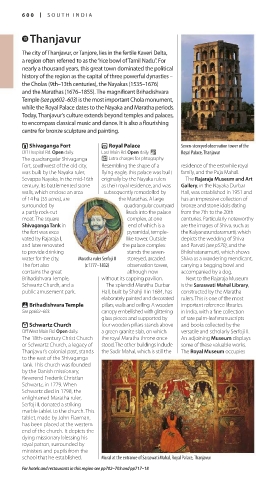
T Shivaganga Fort P Royal Palace Seven-storeyed observation tower of the
Off Hospital Rd. Open daily. East Main Rd. Open daily. & Royal Palace, Thanjavur
The quadrangular Shivaganga ^ Extra charges for phtography.
Fort, southwest of the old city, Resembling the shape of a residence of the erstwhile royal
was built by the Nayaka ruler, flying eagle, this palace was built family, and the Puja Mahal.
Sevappa Nayaka, in the mid-16th originally by the Nayaka rulers The Rajaraja Museum and Art
century. Its battlemented stone as their royal residence, and was Gallery, in the Nayaka Durbar
walls, which enclose an area subsequently remodelled by Hall, was established in 1951 and
of 14 ha (35 acres), are the Marathas. A large has an impressive collection of
surrounded by quadrangular courtyard bronze and stone idols dating
a partly rock-cut leads into the palace from the 7th to the 20th
moat. The square complex, at one centuries. Particularly noteworthy
Shivaganga Tank in end of which is a are the images of Shiva, such as
the fort was exca- pyramidal, temple- the Kalyanasundaramurti, which
vated by Rajaraja I, like tower. Outside depicts the wedding of Shiva
and later reno vated the palace complex and Parvati (see p570), and the
to provide drinking stands the seven- Bhikshatanamurti, which shows
water for the city. Maratha ruler Serfoji II storeyed, arcaded Shiva as a wandering mendicant,
The fort also (r.1777–1832) observation tower, carrying a begging bowl and
contains the great although now accompanied by a dog.
Brihadishvara Temple, without its capping pavilion. Next to the Rajaraja Museum
Schwartz Church, and a The splendid Maratha Durbar is the Saraswati Mahal Library,
public amusement park. Hall, built by Shahji II in 1684, has constructed by the Maratha
elaborately painted and decorated rulers. This is one of the most
Brihadishvara Temple pillars, walls and ceiling. A wooden important reference libraries
See pp602–603. canopy embellished with glittering in India, with a fine collection
glass pieces and supported by of rare palm-leaf manuscripts
R Schwartz Church four wooden pillars stands above and books collected by the
Off West Main Rd. Open daily. a green granite slab, on which versatile and scholarly Serfoji II.
The 18th-century Christ Church the royal Maratha throne once An adjoining Museum displays
or Schwartz Church, a legacy of stood. The other buildings include some of these valuable works.
Thanjavur’s colonial past, stands the Sadir Mahal, which is still the The Royal Museum occupies
to the east of the Shivaganga
Tank. This church was founded
by the Danish missionary,
Reverend Frederik Christian
Schwartz, in 1779. When
Schwartz died in 1798, the
enlightened Maratha ruler,
Serfoji II, donated a striking
marble tablet to the church. This
tablet, made by John Flaxman,
has been placed at the western
end of the church. It depicts the
dying missionary blessing his
royal patron, surrounded by
min isters and pupils from the
school that he established. Mural at the entrance of Saraswati Mahal, Royal Palace, Thanjavur
For hotels and restaurants in this region see pp702–703 and pp717–18
600-601_EW_India.indd 600 26/04/17 11:49 am
Eyewitness Travel LAYERS PRINTED:
Catalogue template “UK” LAYER
(Source v2.4)
Date 25th April 2013
Size 125mm x 217mm

