


Page 661 - (DK Eyewitness) Travel Guide - India
P. 661
KER ALA 659
s Mahe
Union Territory of Puducherry.
Mahe district. 48 km (30 miles)
N of Kozhikode. @ _ St Theresa’s
Feast (Oct).
Situated on the Mayyazhi river,
this former French enclave is
named after the French admiral,
Mahe de La Bourdonnais, who
landed here in November 1741.
A French colony until 1954, it is
today part of the Union Territory
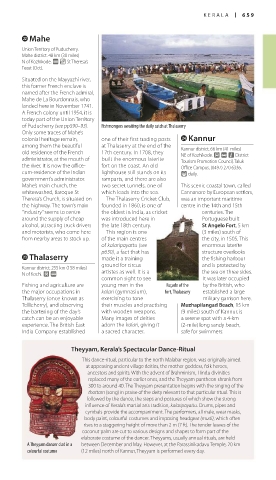
of Puducherry (see pp590–93). Fishmongers awaiting the daily catch at Thalaserry
Only some traces of Mahe’s
colonial heritage remain, one of their first trading posts f Kannur
among them the beautiful at Thalaserry at the end of the Kannur district. 66 km (41 miles)
old residence of the French 17th century. In 1708, they NE of Kozhikode. £ @ n District
administrator, at the mouth of built the enormous laterite Tourism Promotion Council, Taluk
the river. It is now the office- fort on the coast. An old Office Campus, (0497) 270 6336.
cum-residence of the Indian lighthouse still stands on its ( daily.
government’s admin istrator. ramparts, and there are also
Mahe’s main church, the two secret tunnels, one of This scenic coastal town, called
whitewashed, Baroque St which leads into the sea. Cannanore by European settlers,
Theresa’s Church, is situated on The Thalaserry Cricket Club, was an important maritime
the highway. The town’s main founded in 1860, is one of centre in the 14th and 15th
“industry” seems to centre the oldest in India, as cricket centuries. The
around the supply of cheap was introduced here in Portuguese built
alcohol, attracting truck drivers the late 18th century. St Angelo Fort, 5 km
and motorists, who come here This region is one (3 miles) south of
from nearby areas to stock up. of the main centres the city, in 1505. This
of kalaripayattu (see enormous laterite
p630), a fact that has structure overlooks
d Thalaserry made it a training the fishing harbour
Kannur district. 255 km (158 miles) ground for circus and is protected by
N of Kochi. £ @ artistes as well. It is a the sea on three sides.
common sight to see It was later occupied
Fishing and agriculture are young men in the Façade of the by the British, who
the major occupations in kalari (gym nasium), fort, Thalassery established a large
Thalaserry (once known as exercising to tone military garrison here.
Tellicherry), and observing their muscles and practising Muzhapilangad Beach, 15 km
the bartering of the day’s with wooden weapons. (9 miles) south of Kannur, is
catch can be an enjoyable Many images of deities a serene spot with a 4-km
experience. The British East adorn the kalari, giving it (2-mile) long sandy beach,
India Company established a sacred character. safe for swimmers.
Theyyam, Kerala’s Spectacular Dance-Ritual
This dance-ritual, particular to the north Malabar region, was originally aimed
at appeasing ancient village deities, the mother goddess, folk heroes,
ancestors and spirits. With the advent of Brahminism, Hindu divinities
replaced many of the earlier ones, and the Theyyam pantheon shrank from
300 to around 40. The Theyyam presen tation begins with the singing of the
thottam (song) in praise of the deity relevant to that particular ritual. This is
followed by the dance, the steps and postures of which show the strong
influence of Kerala’s martial arts tradition, kalaripayattu. Drums, pipes and
cymbals provide the accompaniment. The performers, all male, wear masks,
body paint, colourful costumes and imposing headgear (mudi), which often
rises to a staggering height of more than 2 m (7 ft). The tender leaves of the
coconut palm are cut to various designs and shapes to form part of the
elaborate costume of the dancer. Theyyams, usually annual rituals, are held
A Theyyam dancer clad in a between December and May. However, at the Parassinikadavu Temple, 20 km
colourful costume (12 miles) north of Kannur, Theyyam is performed every day.
658-659_EW_India.indd 659 26/04/17 11:50 am

