


Page 663 - (DK Eyewitness) Travel Guide - India
P. 663
KER ALA 661
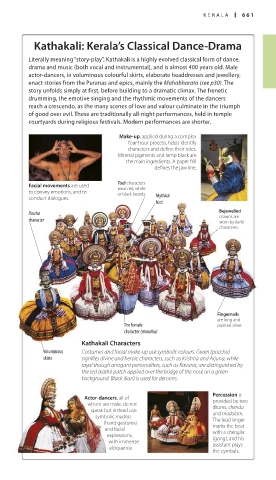
Kathakali: Kerala’s Classical Dance-Drama
Literally meaning “story-play”, Kathakali is a highly evolved classical form of dance,
drama and music (both vocal and instrumental), and is almost 400 years old. Male
actor-dancers, in voluminous colourful skirts, elaborate headdresses and jewellery,
enact stories from the Puranas and epics, mainly the Mahabharata (see p30). The
story unfolds simply at first, before building to a dramatic climax. The frenetic
drumming, the emotive singing and the rhythmic movements of the dancers
reach a crescendo, as the many scenes of love and valour culminate in the triumph
of good over evil. These are traditionally all-night performances, held in temple
courtyards during religious festivals. Modern performances are shorter.
Make-up, applied during a complex
four-hour process, helps identify
characters and define their roles.
Mineral pigments and lamp black are
the main ingredients. A paper frill
defines the jaw line.
Tadi characters
Facial movements are used wear red, white
to convey emotions, and to or black beards.
conduct dialogues. Mythical
bird
Paccha Bejewelled
crowns are
character worn by kathi
characters.
Fingernails
are long and
The female painted silver.
character (minukku)
Kathakali Characters
Voluminous Costumes and facial make-up use symbolic colours. Green (paccha)
skirts signifies divine and heroic characters, such as Krishna and Arjuna, while
royal though arrogant personalities, such as Ravana, are distinguished by
the red (kathi) patch applied over the bridge of the nose on a green
background. Black (kari) is used for demons.
Percussion is
Actor-dancers, all of provided by two
whom are male, do not drums, chenda
speak but instead use and madalam.
symbolic mudras The lead singer
(hand gestures) marks the beat
and facial with a chengila
expressions, (gong), and his
with immense assistant plays
eloquence.
the cymbals.
660-661_EW_India.indd 661 26/04/17 11:50 am

