


Page 666 - (DK Eyewitness) Travel Guide - India
P. 666
664 SOUTH INDIA
1 Hyderabad
The fifth largest city in India, Hyderabad was founded in 1591
and planned as a grid with the Charminar (see pp666–7) at
its centre. It has now grown well beyond the confines of the
original walled city, to include another town north of the
Musi river, the military canton ment at Secunderabad, and
a burgeoning high-tech estate, nicknamed “Cyberabad”. The
city’s sights include the grand palaces of its erstwhile rulers, the
Nizams, and the colourful bazaars and mosques of the old city.
E Salarjung Museum
Near Naya Pul. Tel (040) 2457 6443. Portraits of Salarjung III and his son,
Open daily. Closed public hols. painted on ivory
& 8
This eclectic collection of over by some 19th-century statuary,
40,000 objects once belonged while the collection of oil
to Salarjung III, Prime Minister paintings include a Canaletto,
of Hyderabad between 1912 a Guardi and a Landseer.
and 1914. Salarjung’s highly
individual taste ranged from P Osmania General
objects of sublime beauty to Hospital
some bordering on kitsch, which Afzalganj. Tel (040) 2460 0146.
is what makes this museum Open daily.
so fascinating. A spectacular stone building
The pride of the museum is with soaring domes, Osmania
the outstanding Mughal jade General Hospital was built in
collection, which includes an 1925 as part of the seventh
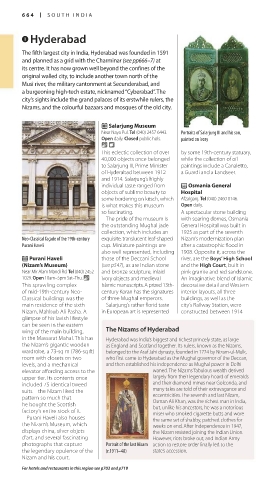
Neo-Classical façade of the 19th-century exquisite, translucent leaf-shaped Nizam’s modernization plan
Purani Haveli cup. Miniature paintings are after a catastrophic flood in
also well represented, including 1908. Opposite it, across the
E Purani Haveli those of the Deccani School river, are the Boys’ High School
(Nizam’s Museum) (see p547), as are Indian stone and the High Court, built in
Near Mir Alam Mandi Rd. Tel (040) 2452 and bronze sculpture, inlaid pink granite and red sandstone.
1029. Open 10am–5pm Sat–Thu. & ivory objects and medieval An imaginative blend of Islamic
This sprawling complex Islamic manuscripts. A prized 13th- decorative detail and Western
of mid-19th-century Neo- century Koran has the signatures interior layouts, all three
Classical buildings was the of three Mughal emperors. buildings, as well as the
main residence of the sixth Salarjung’s rather florid taste city’s Railway Station, were
Nizam, Mahbub Ali Pasha. A in European art is represented constructed between 1914
glimpse of his lavish lifestyle
can be seen in the eastern
wing of the main building, The Nizams of Hyderabad
in the Massarat Mahal. This has Hyderabad was India’s biggest and richest princely state, as large
the Nizam’s gigantic wooden as England and Scotland together. Its rulers, known as the Nizams,
wardrobe, a 73-sq m (786-sq ft) belonged to the Asaf Jahi dynasty, founded in 1724 by Nizam-ul-Mulk,
room with closets on two who first came to Hyderabad as the Mughal governor of the Deccan,
levels, and a mechanical and then established his independence as Mughal power in Delhi
elevator affording access to the waned. The Nizams’ fabulous wealth derived
upper tier. Its contents once largely from their leg endary hoard of emeralds
included 75 identical tweed and their diamond mines near Golconda, and
suits – the Nizam liked the many tales are told of their extravagance and
pattern so much that eccentricities. The seventh and last Nizam,
Osman Ali Khan, was the richest man in India,
he bought the Scottish but, unlike his ancestors, he was a notorious
factory’s entire stock of it. miser who smoked cigarette butts and wore
Purani Haveli also houses the same set of shabby, patched clothes for
the Nizam’s Museum, which weeks on end. After Independence in 1947,
displays china, silver objets the Nizam resisted joining the Indian Union.
d’art, and several fascinating However, riots broke out, and Indian Army
photographs that capture Portrait of the last Nizam action to restore order finally led to the
the legendary opulence of the (r.1911–48) state’s accession.
Nizam and his court.
For hotels and restaurants in this region see p703 and p719
664-665_EW_India.indd 664 26/04/17 11:50 am
Eyewitness Travel LAYERS PRINTED:
Catalogue template “UK” LAYER
(Source v2.4)
Date 25th April 2013
Size 125mm x 217mm

