


Page 671 - (DK Eyewitness) Travel Guide - India
P. 671
ANDHR A PR ADESH AND TELANGANA 669
Hyderabadi Culture
Sultan Muhammad Quli Qutb Shah, who founded Hyderabad in 1591, was an
enlightened ruler, and a poet, scholar and patron of the arts. His kingdom was also
a flourishing centre of trade, especially in pearls, diamonds and horses. At his court
and in his bazaars, Hyderabadis rubbed shoulders with traders, scholars and artisans
from different lands. This cosmopolitan tradition, and the culture of courtly elegance
and etiquette, continued with the next dynasty – that of the Asaf Jahi Nizams, who
ruled from 1724 until 1947. As a result, Hyderabad has a uniquely composite culture,
a mélange of Hindu and Muslim customs, mingled with Arab, Persian and Turkish
influences, evident in its language, food, manners and arts.
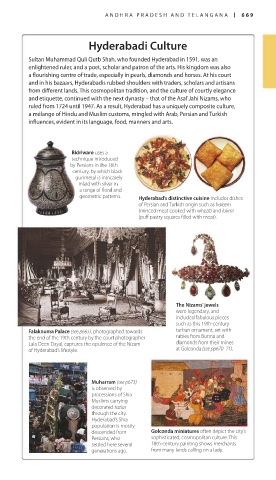
Bidriware uses a
technique introduced
by Persians in the 16th
century, by which black
gunmetal is intricately
inlaid with silver in
a range of floral and
geometric patterns. Hyderabad’s distinctive cuisine includes dishes
of Persian and Turkish origin such as haleem
(minced meat cooked with wheat) and lukmi
(puff pastry squares filled with meat).
The Nizams’ jewels
were legendary, and
included fabulous pieces
such as this 19th-century
Falaknuma Palace (see p665), photographed towards turban ornament, set with
the end of the 19th century by the court photographer rubies from Burma and
Lala Deen Dayal, captures the opulence of the Nizam diamonds from their mines
of Hyderabad’s lifestyle. at Golconda (see pp670–71).
Muharram (see p673)
is observed by
processions of Shia
Muslims carrying
decorated tazias
through the city.
Hyderabad’s Shia
population is mostly
descended from Golconda miniatures often depict the city’s
Persians, who sophisticated, cosmopolitan culture. This
settled here several 18th-century painting shows merchants
generations ago. from many lands calling on a lady.
668-669_EW_India.indd 669 26/04/17 11:50 am

