


Page 674 - (DK Eyewitness) Travel Guide - India
P. 674
672 SOUTH INDIA
3 Pochampalli gateways at the cardinal points.
At its geometric centre, four
Nalgonda district. 41 km (26 miles)
E of Hyderabad. @ ( daily. ornate toranas (gateways),
marking the sacred precinct, are
Andhra Pradesh’s ikat belt, where the only remains of a great Shiva
intricate tie-and-dye textiles temple that once stood here.
are woven, borders Hyderabad. The toranas themselves are
Pochampalli, the name by which remarkable for their size
most of the state’s ikat fabric is and beauty.
known, is the largest centre for A short distance to the west is
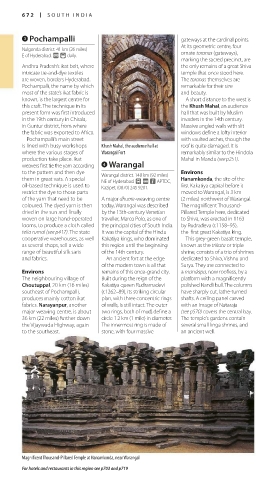
this craft. The technique in its the Khush Mahal, an audience
present form was first introduced hall that was built by Muslim
in the 19th century in Chirala, invaders in the 14th century.
in Guntur district, from where Massive angled walls with slit
the fabric was exported to Africa. windows define a lofty interior
Pochampalli’s main street with vaulted arches, though the
is lined with busy workshops Khush Mahal, the audience hall at roof is quite damaged. It is
where the various stages of Warangal Fort remarkably similar to the Hindola
production take place. Ikat Mahal in Mandu (see p251).
weavers first tie the yarn according 4 Warangal
to the pattern and then dye Warangal district. 148 km (92 miles) Environs
them in great vats. A special NE of Hyderabad. £ @ n APTDC, Hanamkonda, the site of the
oil-based technique is used to Kazipet, (0870) 245 9201. first Kakatiya capital before it
restrict the dye to those parts moved to Warangal, is 3 km
of the yarn that need to be A major dhurrie-weaving centre (2 miles) northwest of Warangal.
coloured. The dyed yarn is then today, Warangal was described The magnificent Thousand-
dried in the sun and finally by the 13th-century Venetian Pillared Temple here, dedicated
woven on large hand-operated traveller, Marco Polo, as one of to Shiva, was erected in 1163
looms, to produce a cloth called the principal cities of South India. by Rudradeva (r.1158–95),
telia rumal (see p417). The state It was the capital of the Hindu the first great Kakatiya king.
cooperative warehouses, as well Kakatiya kings, who dominated This grey-green basalt temple,
as several shops, sell a wide this region until the beginning known as the trikuta or triple
range of beautiful silk saris of the 14th century. shrine, consists of a trio of shrines
and fabrics. An ancient fort at the edge dedicated to Shiva, Vishnu and
of the modern town is all that Surya. They are connected to
Environs remains of this once-grand city. a mandapa, now roofless, by a
The neighbouring village of Built during the reign of the platform with a magnificently
Choutuppal, 20 km (16 miles) Kakatiya queen Rudramadevi polished Nandi bull. The columns
southeast of Pochampalli, (r.1262–89), its striking circular have sharply cut, lathe-turned
produces mainly cotton ikat plan, with three concentric rings shafts. A ceiling panel carved
fabrics. Narayanpur, another of walls, is still intact. The outer with an image of Nataraja
major weaving centre, is about two rings, both of mud, define a (see p570) covers the central bay.
36 km (22 miles) further down circle 1.2 km (1 mile) in diameter. The temple’s gardens contain
the Vijaywada Highway, again The innermost ring is made of several small linga shrines, and
to the southeast. stone, with four massive an ancient well.
Magnificent Thousand-Pillared Temple at Hanamkonda, near Warangal
For hotels and restaurants in this region see p703 and p719
672-673_EW_India.indd 672 26/04/17 11:50 am
Eyewitness Travel LAYERS PRINTED:
Catalogue template “UK” LAYER
(Source v2.6)
Date 12th July 2013
Size 125mm x 217mm

