


Page 686 - (DK Eyewitness) Travel Guide - India
P. 686
684 SOUTH INDIA
sword together with the
sun and the moon, are
intricately carved on to the
walls of this seven-storeyed
towered gateway.
Nearby, similar but smaller
gopuras provide access to
the Kalahastishvara Temple,
the town’s main attraction,
surrounded by a paved
rectangular compound. A
doorway to the south leads
into a crowded enclosure of
columned halls, pavilions, lamp
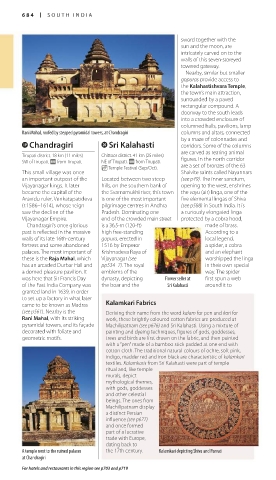
Rani Mahal, roofed by stepped pyramidal towers, at Chandragiri columns and altars, connected
by a maze of colonnades and
o Chandragiri p Sri Kalahasti corridors. Some of the columns
are carved as rearing animal
Tirupati district. 18 km (11 miles) Chittoor district. 41 km (25 miles)
SW of Tirupati. @ from Tirupati. NE of Tirupati. @ from Tirupati. figures. In the north corridor
_ Temple Festival (Sep/Oct). are a set of bronzes of the 63
This small village was once Shaivite saints called Nayannars
an important outpost of the Located between two steep (see p49). The inner sanctum,
Vijayanagar kings. It later hills, on the southern bank of opening to the west, enshrines
became the capital of the the Svarnamukhi river, this town the vayu (air) linga, one of the
Aravidu ruler, Venkatapatideva is one of the most imp ortant five elemental lingas of Shiva
(r.1586–1614), whose reign pilgrimage centres in Andhra (see p588) in South India. It is
saw the decline of the Pradesh. Dominating one a curiously elongated linga
Vijayanagar Empire. end of the crowded main street protected by a cobra hood,
Chandragiri’s once glorious is a 36.5-m (120-ft) made of brass.
past is reflected in the massive high free-standing According to a
walls of its late 16th-century gopura, erected in local legend,
fortress and some abandoned 1516 by Emperor a spider, a cobra
palaces. The most important of Krishna deva Raya of and an elephant
these is the Raja Mahal, which Vijayanagar (see worshipped the linga
has an arcaded Durbar Hall and pp534–7). The royal in their own special
a domed pleasure pavilion. It emblems of the way. The spider
was here that Sir Francis Day dynasty, depicting Flower seller at first spun a web
of the East India Company was the boar and the Sri Kalahasti around it to
granted land in 1639, in order
to set up a factory in what later
came to be known as Madras Kalamkari Fabrics
(see p561). Nearby is the Deriving their name from the word kalam for pen and kari for
Rani Mahal, with its striking work, these brightly coloured cotton fabrics are produced at
pyramidal towers, and its façade Machilipatnam (see p676) and Sri Kalahasti. Using a mixture of
decorated with foliate and painting and dyeing techniques, figures of gods, goddesses,
geometric motifs. trees and birds are first drawn on the fabric, and then painted
with a “pen” made of a bamboo stick padded at one end with
cotton cloth. The traditional natural colours of ochre, soft pink,
indigo, madder red and iron black are characteristic of kalamkari
textiles. Kalamkaris from Sri Kalahasti were part of temple
ritual and, like temple
murals, depict
mythological themes,
with gods, goddesses
and other celestial
beings. The ones from
Machilipatnam display
a distinct Persian
influence (see p677)
and once formed
part of a lucrative
trade with Europe,
dating back to
A temple next to the ruined palaces the 17th century. Kalamkari depicting Shiva and Parvati
at Chandragiri
For hotels and restaurants in this region see p703 and p719
684-685_EW_India.indd 684 26/04/17 11:50 am
Eyewitness Travel LAYERS PRINTED:
Catalogue template “UK” LAYER
(Source v2.6)
Date 12th July 2013
Size 125mm x 217mm

