


Page 682 - (DK Eyewitness) Travel Guide - India
P. 682
680 SOUTH INDIA
t Nagarjunakonda
Guntur district. 189 km (117 miles)
W of Vijayawada. £ Macherla,
22 km (14 miles) SE of site, then
bus to Vijayapuri. @ 4 daily from
Vijayapuri, except Fri. n Vijay Vihar,
(08680) 277 362. 8 from Hyderabad.
Nagarjunakonda or “Nagarjuna’s
Hill”, on the banks of the Krishna
river, was named after Nagarjuna
Acha rya, the 2nd-century
Buddhist theologian and founder
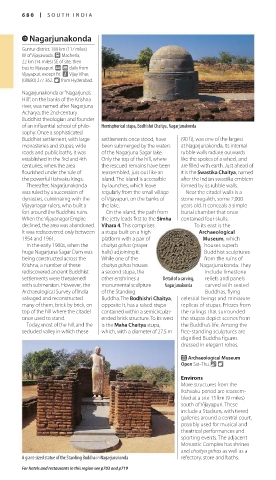
of an influential school of philo- Hemispherical stupa, Bodhishri Chaitya, Nagarjunakonda
sophy. Once a sophisticated
Buddhist settlement, with large settlements once stood, have (90 ft), was one of the largest
monasteries and stupas, wide been submerged by the waters at Nagarjunakonda. Its internal
roads and public baths, it was of the Nagarjuna Sagar lake. rubble walls radiate outwards
established in the 3rd and 4th Only the top of the hill, where like the spokes of a wheel, and
centuries, when the area the rescued remains have been are filled with earth. Just ahead of
flourished under the rule of reassembled, juts out like an it is the Swastika Chaitya, named
the powerful Ikshvaku kings. island. The island is accessible after the Indian swastika emblem
Thereafter, Nagarjunakonda by launches, which leave formed by its rubble walls.
was ruled by a succession of regularly from the small village Near the citadel walls is a
dynasties, culminating with the of Vijayapuri, on the banks of stone megalith, some 2,000
Vijayanagar rulers, who built a the lake. years old. It conceals a simple
fort around the Buddhist ruins. On the island, the path from burial chamber that once
When the Vijayanagar Empire the jetty leads first to the Simha contained four skulls.
declined, the area was abandoned. Vihara 4. This comprises To its east is the
It was rediscovered only between a stupa built on a high Archaeological
1954 and 1961. platform with a pair of Museum, which
In the early 1960s, when the chaitya grihas (prayer houses superb
huge Nagarjuna Sagar Dam was halls) adjoining it. Buddhist sculptures
being constructed across the While one of the from the ruins of
Krishna, a number of these chaitya grihas houses Nagarjunakonda. They
rediscovered ancient Buddhist a second stupa, the include limestone
settlements were threatened other enshrines a Detail of a carving, reliefs and panels
with submersion. However, the monumental sculpture Nagarjunakonda carved with seated
Archaeological Survey of India of the Standing Buddhas, flying
salvaged and reconstructed Buddha. The Bodhishri Chaitya, celestial beings and miniature
many of them, brick by brick, on opposite it, has a raised stupa replicas of stupas. Friezes from
top of the hill where the citadel contained within a semicircular- the railings that surrounded
once used to stand. ended brick structure. To its west the stupas depict scenes from
Today, most of the hill, and the is the Maha Chaitya stupa, the Buddha’s life. Among the
secluded valley in which these which, with a diameter of 27.5 m free-standing sculptures are
dignified Buddha figures
dressed in elegant robes.
E Archaeological Museum
Open Sat–Thu. & 8
Environs
More structures from the
Ikshvaku period are reassem-
bled at a site 15 km (9 miles)
south of Vijayapuri. These
include a Stadium, with tiered
galleries around a central court,
possibly used for musical and
theatrical performances and
sporting events. The adjacent
Monastic Complex has shrines
and chaitya grihas as well as a
A giant-sized statue of the Standing Buddha in Nagarjunakonda refectory, store and baths.
For hotels and restaurants in this region see p703 and p719
680-681_EW_India.indd 680 26/04/17 11:50 am
Eyewitness Travel LAYERS PRINTED:
Catalogue template “UK” LAYER
(Source v2.6)
Date 12th July 2013
Size 125mm x 217mm

