


Page 681 - (DK Eyewitness) Travel Guide - India
P. 681
ANDHR A PR ADESH AND TELANGANA 679
fragments discovered in 1980.
A part of the stupa’s railing,
decorated with scenes from the
Buddha’s life, is reconstructed in
the courtyard. Other exhibits
include an instructive model
of the original monument and
superb sculptures of the Bodhi
Tree, under which the Buddha
is said to have meditated.
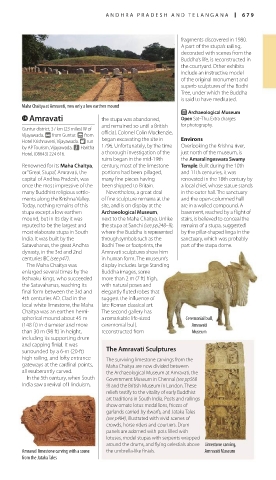
Maha Chaitya at Amravati, now only a low earthen mound
E Archaeological Museum
r Amravati the stupa was abandoned, Open Sat–Thu. Extra charges
and remained so until a British for photography.
Guntur district. 37 km (23 miles) W of
Vijayawada. @ from Guntur. 4 from official, Colonel Colin Mackenzie,
Hotel Krishnaveni, Vijayawada. 8 run began excavating the site in Environs
by AP Tourism, Vijayawada. n Haritha 1796. Unfortunately, by the time Overlooking the Krishna river,
Hotel, (08643) 224 616. a thorough investigation of the just north of the museum, is
ruins began in the mid-19th the Amaralingeswara Swamy
Renowned for its Maha Chaitya, century, most of the limestone Temple. Built during the 10th
or “Great Stupa”, Amravati, the portions had been pillaged, and 11th centuries, it was
capital of Andhra Pradesh, was many fine pieces having renovated in the 18th century by
once the most impressive of the been shipped to Britain. a local chief, whose statue stands
many Buddhist religious settle- Nevertheless, a great deal in the outer hall. The sanctuary
ments along the Krishna Valley. of fine sculpture remains at the and the open-columned hall
Today, nothing remains of this site, and is on display at the are in a walled compound. A
stupa except a low earthen Archaeological Museum, basement, reached by a flight of
mound, but in its day it was next to the Maha Chaitya. Unlike stairs, is believed to conceal the
reputed to be the largest and the stupa at Sanchi (see pp248–9), remains of a stupa, suggested
most elaborate stupa in South where the Buddha is represented by the pillar-shaped linga in the
India. It was built by the through symbols such as the sanctuary, which was probably
Satavahanas, the great Andhra Bodhi Tree or footprints, the part of the stupa dome.
dynasty, in the 3rd and 2nd Amravati sculptures show him
centuries BC (see p47). in human form. The museum’s
The Maha Chaitya was display includes large Standing
enlarged several times by the Buddha images, some
Ikshvaku kings, who succeeded more than 2 m (7 ft) high,
the Satavahanas, reaching its with natural poses and
final form between the 3rd and elegantly fluted robes that
4th centuries AD. Clad in the suggest the influence of
local white limestone, the Maha late Roman classical art.
Chaitya was an earthen hemi- The second gallery has
spherical mound about 45 m a remarkable life-sized Ceremonial bull,
(148 ft) in diameter and more ceremonial bull, Amravati
than 30 m (98 ft) in height, reconstructed from Museum
including its supporting drum
and capping finial. It was
surrounded by a 6-m (20-ft) The Amravati Sculptures
high railing, and lofty entrance The surviving limestone carvings from the
gate ways at the cardinal points, Maha Chaitya are now divided bet ween
all exuberantly carved. the Archaeological Museum at Amravati, the
In the 5th century, when South Government Museum in Chennai (see pp568–
India saw a revival of Hinduism, 9) and the British Museum in London. These
reliefs tes tify to the vitality of early Buddhist
art traditions in South India. Posts and railings
show ornate lotus medallions, friezes of
garlands carried by dwarfs, and Jataka Tales
(see p484), illustrated with vivid scenes of
crowds, horse riders and courtiers. Drum
panels are adorned with pots filled with
lotuses, model stupas with serpents wrapped
around the drums, and flying celestials above Limestone carving,
Amravati limestone carving with a scene the umbrella-like finials. Amravati Museum
from the Jataka Tales
678-679_EW_India.indd 679 26/04/17 11:50 am

