


Page 106 - (DK Eyewitness) Travel Guide: Japan
P. 106
104 T OK Y O AREA B Y AREA
Farther Afield for daily use, and representative
of the region from which it
A short distance from Tokyo city center are a number of comes. The museum building,
interesting sights. The Japan Folk Crafts Museum and Goto designed by Yanagi and
Art Museum are small gems in pleasant neighborhoods that completed in 1936, uses black
give an idea of Tokyo life as well as its heritage; in contrast tiles and white stucco outside.
On display are items ranging
Ikebukuro, Daiba, and Ebisu are all modern urban centers in from woven baskets to ax
their own right. Ryogoku, the place for all things sumo, also sheaths, iron kettles, pottery,
has the Edo-Tokyo Museum. Rikugi-en, near Ikebukuro, is one and kimonos; together they
of Edo’s last great stroll gardens. present a fascinating view of
rural life. There are also special
themed exhibits, such as
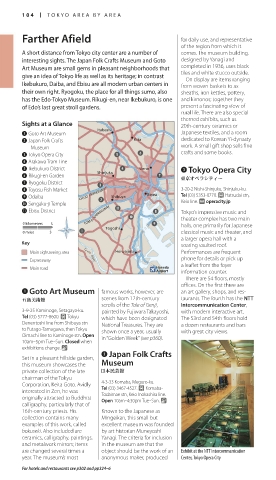
Sights at a Glance 20th-century ceramics or
Itabashi
1 Goto Art Museum Japanese textiles, and a room
2 Japan Folk Crafts Kita dedicated to Korean Yi-dynasty
Museum work. A small gift shop sells fine
3 Tokyo Opera City crafts and some books.
4 Arakawa Tram Line
5 Ikebukuro District Shinjuku Ueno 3 Tokyo Opera City
6 Rikugi-en Garden Tokyo Opera City
7 Ryogoku District
8 Toyosu Fish Market CHUO EXPRESSWAY 3-20-2 Nishi-Shinjuku, Shinjuku-ku.
9 Odaiba Shibuya Ginza Tel (03) 5353-0770. £ Hatsudai stn,
0 Sengaku-ji Temple Keio line. ∑ operacity.jp
q Ebisu District TOM EI EXPRESSWAY Tokyo’s impressive music and
0 kilometers 5 theater complex has two main
halls, one primarily for Japanese
Togoshi
0 miles 3 classical music and theater, and
a larger opera hall with a
Key
soaring vaulted roof.
Main sightseeing area Ta ma River Heiwajima Performances are fre quent –
Expressway phone for details or pick up
a leaflet from the foyer
Main road Haneda
Airport information counter.
There are 54 floors, mostly
offices. On the first three are
1 Goto Art Museum famous works, however, are an art gallery, shops, and res-
scenes from 12th-century
Goto Art Museum taurants. The fourth has the NTT
scrolls of the Tale of Genji, Intercommunication Center,
3-9-25 Kaminoge, Setagaya-ku. painted by Fujiwara Takayoshi, with modern inter active art.
Tel (03) 5777-8600. £ Tokyu which have been designated The 53rd and 54th floors hold
Denentoshi line from Shibuya stn National Treasures. They are a dozen restaurants and bars
to Futago-Tamagawa, then Tokyu shown once a year, usually with great city views.
Oimachi line to Kaminoge stn. Open in “Golden Week” (see p360).
10am–5pm Tue–Sun. Closed when
exhibitions change. &
2 Japan Folk Crafts
Set in a pleasant hillside garden,
this museum show cases the Museum
private collection of the late Japan Folk Craft Museum
chairman of the Tokyu 4-3-33 Komaba, Meguro-ku.
Corporation, Keita Goto. Avidly Tel (03) 3467-4527. £ Komaba-
interested in Zen, he was Todaimae stn, Keio Inokashira line.
originally attracted to Buddhist Open 10am–4:30pm Tue–Sun. &
calligraphy, particu larly that of
16th-century priests. His Known to the Japanese as
collection contains many Mingeikan, this small but
examples of this work, called excellent museum was found ed
bokuseki. Also included are by art historian Muneyoshi
ceramics, calligraphy, paint ings, Yanagi. The criteria for inclusion
and metalwork mirrors; items in the museum are that the
are changed several times a object should be the work of an Exhibit at the NTT Intercommuni cation
year. The museum’s most anonymous maker, produced Center, Tokyo Opera City
For hotels and restaurants see p302 and pp324–6
104-105_EW_Japan.indd 104 08/08/16 2:53 pm

