


Page 108 - (DK Eyewitness) Travel Guide: Japan
P. 108
106 T OK Y O AREA B Y AREA
7 Ryogoku District
Life in a Sumo Stable
Ryogoku District
At the age of about 15 boys are accepted into a sumo beya. From
Map 4 E4–5. Ryogoku stn, Toei- that day, they will probably not return home or see their parents
Oedo line. £ Ryogoku stn, JR for several years. Sumo society is supremely hierarchical, with
Sobu line. Sumo Museum: 1-3-28 newcomers serving senior wrestlers as well as cleaning and cooking
Yokoami, Sumida-ku. Tel (03) 3622- for the entire beya. Their practices may start at 4am, with seniors
0366. Open 10am–4:30pm Mon– starting about 6am. The day’s single meal of chanko-nabe, a large
Fri. Closed public hols. ∑ sumo. stew, comes about noon with juniors getting what the seniors leave.
or.jp Edo-Tokyo Museum: 1-4-1 That is followed by more work. The life is grueling – but it is a society
Yokoami, Sumida-ku. Tel (03) 3626- and culture several foreigners have very successfully entered.
9974. Open 9:30am–5:30pm
Tue–Sun (7:30pm Sat). &
∑ edo-tokyo-museum.or.jp
On the east bank of the Sumida
River, Ryogoku was a great
entertainment and commerce
center in Edo’s Shitamachi. These
days it is a quiet place but it still
has its most famous resi dents:
sumo wrestlers. Many beya
(sumo stables) are here, and it is
not unusual to see huge young
men walking the streets in
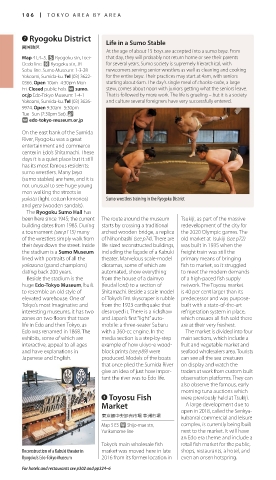
yukata (light cotton kimonos) Sumo wrestlers training in the Ryogoku District
and geta (wooden sandals).
The Ryogoku Sumo Hall has
been here since 1945; the current The route around the museum Tsukiji, as part of the massive
building dates from 1985. During starts by crossing a traditional redevelopment of the city for
a tourna ment (see p115) many arched wooden bridge, a replica the 2020 Olympic games. The
of the wrestlers simply walk from of Nihon bashi (see p74). There are old market at Tsukiji (see p72)
their beya down the street. Inside life-sized recon structed buildings, was built in 1935 when the
the stadium is a Sumo Museum including the façade of a Kabuki freight train was still the
lined with portraits of all the theater. Marvelous scale-model primary means of bringing
yokozuna (grand champions) dio ramas, some of which are fish to market, so it struggled
dating back 200 years. auto mated, show everything to meet the modern demands
Beside the stadium is the from the house of a daimyo of a high-paced fish supply
huge Edo-Tokyo Museum, built (feudal lord) to a section of network. The Toyosu market
to resemble an old style of Shitamachi. Beside a scale model is 40 per cent larger than its
elevated ware house. One of of Tokyo’s first skyscraper is rubble predecessor and was purpose-
Tokyo’s most imaginative and from the 1923 earthquake that built with a state-of-the-art
interesting museums, it has two destroyed it. There is a rick shaw refrigeration system in place,
zones on two floors that trace and Japan’s first “light” auto- which ensures all fish sold there
life in Edo and then Tokyo, as mobile: a three-seater Subaru are at their very freshest.
Edo was renamed in 1868. The with a 360-cc engine. In the The market is divided into four
exhibits, some of which are media section is a step-by-step main sections, which include a
interactive, appeal to all ages example of how ukiyo-e wood- fruit and vegetable market and
and have explanations in block prints (see p89) were seafood wholesalers area. Tourists
Japanese and English. produced. Models of the boats can see all the sea creatures
that once plied the Sumida River on display and watch the
give an idea of just how impor- traders at work from custom-built
tant the river was to Edo life. observation platforms. They can
also observe the famous, early
morning tuna auctions which
8 Toyosu Fish were previously held at Tsukiji.
Market A large development due to
open in 2018, called the Senkya-
東京都中央卸売市場 豊洲市場 kubanrai commercial and leisure
Map 5 E5 Shijo-mae stn, complex, is currently being built
Yurikamome line next to the market. It will have
an Edo era theme and include a
Tokyo’s main wholesale fish retail fish market for the public,
Reconstruction of a Kabuki theater in market was moved here in late shops, restaurants, a hotel, and
Ryogoku’s Edo-Tokyo Museum 2016 from its former location in even an onsen hotspring.
For hotels and restaurants see p302 and pp324–6
106-107_EW_Japan.indd 106 08/08/16 4:06 pm

